


Every British bathroom has one. It stands in a plastic cup beside the toilet, mostly ignored, occasionally used, and rarely examined — which is unfortunate, because the cup it stands in is quietly the dirtiest object in the room. Water drips off the bristles after every use and sits at the bottom of the cup. The brush head lives in that trapped moisture. Film grows on the base, scale hardens on the bristles, and the tool that is supposed to clean the toilet becomes a thing that needs cleaning itself.
Meanwhile the actual job is never quite done. The brush reaches the sides of the bowl, but the underside of the rim — the ledge where water splashes, minerals crystallize and a dark line forms — stays untouched, because a straight brush physically cannot get there. The two most common complaints about toilet cleaning, that the rim line never disappears and that the brush itself smells, are the same complaint: the tool and its storage are both wrong.
This article is about a brush that was designed against those two failures. It is long-handled, wall-mounted and curved-headed, built from PP and stainless steel, and its entire design can be read as an answer to the two questions every toilet brush quietly fails: how do I reach the rim, and where do I dry?
The Brush in the Corner
Every British bathroom has one. It stands in a plastic cup beside the toilet, mostly ignored, occasionally used, and rarely examined — which is unfortunate, because the cup it stands in is quietly the dirtiest object in the room. Water drips off the bristles after every use and sits at the bottom of the cup. The brush head lives in that trapped moisture. Film grows on the base, scale hardens on the bristles, and the tool that is supposed to clean the toilet becomes a thing that needs cleaning itself.
Meanwhile the actual job is never quite done. The brush reaches the sides of the bowl, but the underside of the rim — the ledge where water splashes, minerals crystallize and a dark line forms — stays untouched, because a straight brush physically cannot get there. The two most common complaints about toilet cleaning, that the rim line never disappears and that the brush itself smells, are the same complaint: the tool and its storage are both wrong.
This article is about a brush that was designed against those two failures. It is long-handled, wall-mounted and curved-headed, built from PP and stainless steel, and its entire design can be read as an answer to the two questions every toilet brush quietly fails: how do I reach the rim, and where do I dry?
The British Bathroom, Its Habits and Its Constraints
The British bathroom is a room of constraints. The housing stock is old — much of it Victorian and interwar — and the rooms are small. A typical terraced-house bathroom has to hold a bath or shower, a basin, a toilet, a towel rail and storage in a space barely larger than a walk-in cupboard. The toilet itself often sits in a tight corner, either in the main bathroom or in a separate WC barely a metre wide. Every object on the floor is an obstacle in a room with no floor to spare.
The British also clean their toilets more than almost anyone else. The weekly toilet-scrubbing routine is embedded in the national domestic culture; the WC is the room guests are judged by, and the phrase "a bit of elbow grease" was coined for exactly this job. Yet the equipment has barely changed in fifty years: a brush and a cup. The brush grows stale, the cup grows grime, and the household replaces the set every year or two without ever solving the two problems the category has never addressed.
Add the climate. Britain is damp, and damp is now a public issue. The government's Housing Health and Safety Rating System classifies damp and mould as category 1 hazards; from June 2026 councils can fine landlords up to £7,000 for refusing to fix severe damp and mould, and from November Awaab's Law extends tenants' rights to faster repairs. In a country where bathroom moisture is a statutory concern, a tool that stores its own water next to the toilet is not merely ugly — it is working against the room. The case for a brush that dries in open air instead of standing in water is not aesthetic. It is damp control at the scale of a daily object.
There is a third pressure: age. The population is older, and the NHS publishes the numbers every year. Falls are the leading cause of hospital admission among older people. Ambulance services record six-figure annual call-outs for falls, and the bathroom is the room where the risk concentrates. Bending to scrub a toilet is one of the most frequent bending routines in an older person's day — and it is exactly the kind of movement that becomes hazardous on a wet floor. A tool that lets the job be done standing up is a small, daily, no-installation fall-prevention measure.
Why the Ordinary Brush Fails
The conventional toilet brush has three structural failures, and it is worth naming them precisely.
First, it cannot reach the rim. The head is straight. Pushed under the rim of the bowl, the bristles meet the ceramic wall at an angle and deflect downward; they contact the vertical wall but never the horizontal underside of the rim. The rim line is the most visible failure of toilet cleaning in Britain, and it exists because the tool's geometry does not match the bowl's geometry. No amount of scrubbing with a straight brush removes what the straight brush cannot touch.
Second, it stores its own dirt. The floor cup is a water trap. Every use drips into it; the water stays; the bristle tips sit in it. The cup is the one object in the bathroom that is deliberately kept damp, and its inner rim, where the brush rests, becomes a permanent dark ring that is almost impossible to clean because it is behind the brush at all times.
Third, it occupies the floor. In a British bathroom, floor space is the scarcest commodity. The cup takes a footprint, gets kicked, gets moved, collects dust behind itself, and makes the corner it lives in feel smaller than it is.
The failures are not cosmetic. They are the reasons the category has a bad reputation: brushes smell, rim lines persist, and the "set" needs replacing every eighteen months. A better brush is not a better handle — it is a different answer to these three failures.
What This Brush Is: A Walk Through the Design
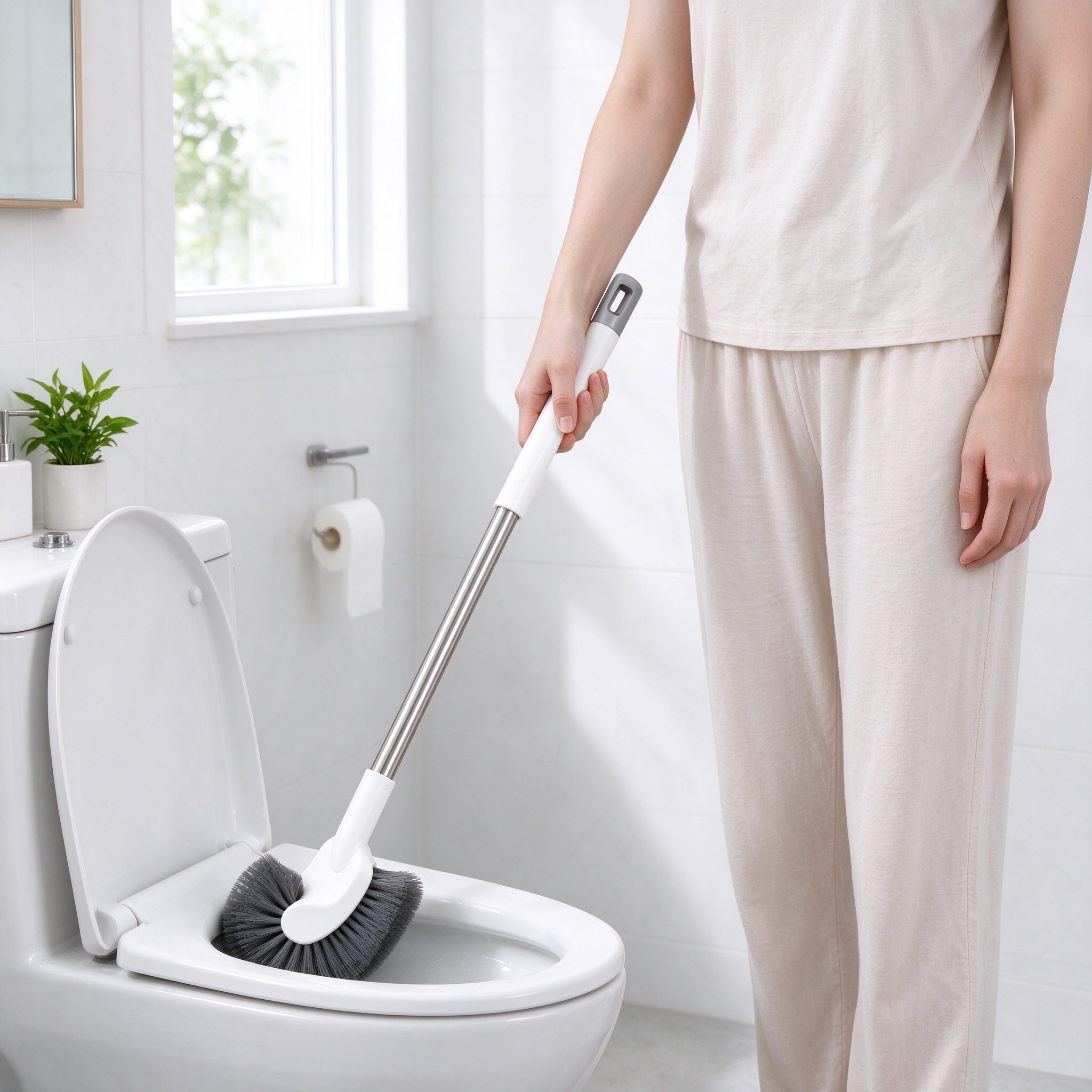
The brush presents itself as a simple object: a long white handle, a brushed stainless-steel grip, a dense head of gray bristles that curves upward, and a molded hanging hole at the top. But each visible choice is a decision against one of the failures above.
The handle is PP plastic. Polypropylene is the standard material for wet-environment tools, and for good reasons: it does not corrode, it tolerates hot water and diluted bleach, and it is light. A long-handled brush needs to be light, because the whole point of the length is that the user does not bend — and a heavy long brush would simply move the fatigue from the back to the arm.
The grip is brushed stainless steel. This is the detail that most distinguishes the product from a cheap brush. The hand lives on the grip, and stainless is the one material that does not go sticky with soap film, does not yellow, and does not grow the grey patina that plastic handles acquire within months in hard water. The metal also adds weight near the hand, which balances the long reach: a brush with mass at the grip pivots at the hand, while a brush with a heavy head wobbles at the tip. Balance is what makes a long handle feel controlled instead of clumsy.
The head is a dense block of gray bristles, and it is curved. The curve is the core of the product — it exists to do what a straight brush cannot, and it will get its own section below. The bristles themselves are firm enough to shift dried scale and film, dense enough to actually scrub rather than polish, and arranged so the pressure spreads across the ceramic without scratching the glaze.
The top of the handle carries the hanging hole, sized for standard bathroom hooks including the no-drill adhesive kind. Hung from a hook, the brush hangs straight down, bristles clear of the wall, water dripping freely from the lowest point. The tool dries in hours, takes no floor space, and leaves no mark on the wall it hangs from.
The Curved Head and the Rim Problem
The underside of a toilet rim is the most interesting surface in the bathroom, because it is the surface everyone tries to clean and no one reaches. Flushing water splashes against it. Minerals from hard water crystallize on it. A dark film forms along it, just above the waterline, and it is the first thing a guest notices and the last thing a straight brush touches.
The geometry is simple. A straight head, pushed under the rim, contacts the wall at an oblique angle and deflects downward. The ledge above — the horizontal underside — never receives bristle pressure. Cleaning a toilet with a straight brush is therefore cleaning only what the brush can reach, and the rim line persists no matter how hard or how often the bowl is scrubbed.
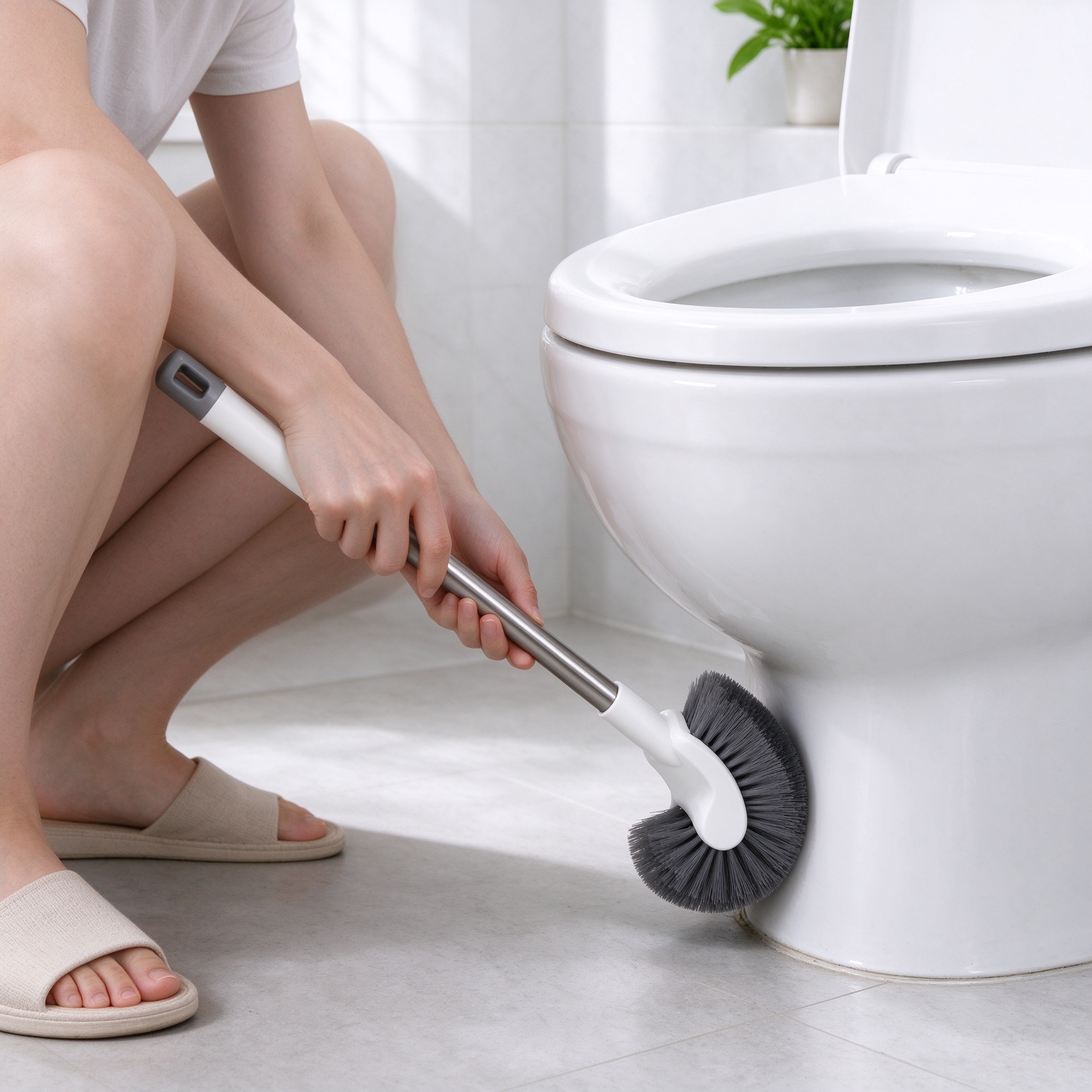
The curved head changes the mechanics at the point of contact. When the brush is pushed under the rim, the outer arc of the bristle head rises into the underside of the ledge, and the bristles press against the surface a straight brush cannot reach. The curve is designed against the rim radius of standard modern toilets — the geometry works on the one-piece bowls that dominate new bathrooms and on traditional two-piece suites. Rock the brush side to side and the arc sweeps the length of the rim's underside; the film is lifted while it is still soft, and a flush carries it away.
Three consequences follow. The visible rim line is actually removed, which is the single most obvious improvement a toilet brush can offer. The small flush ports around the rim perimeter — the holes that direct flushing water — can be swept clean, which keeps the flush pattern strong and removes the odour that collects inside the ports. And the area just inside the waterline, where overnight rings form, becomes reachable with a simple rotation of the head. In hard-water Britain, where scale is the defining bathroom problem, a brush that reaches the scale line weekly means the scale never becomes a monthly descaling job.
Why Hanging Matters: Storage as Drying
The second half of the design is storage, and the storage is the hygiene.
A brush standing in a cup is a brush living in its own condensation. The cup is the anti-drying device: it traps the water that drips off the bristles, keeps the head permanently damp, and provides the one thing bacteria need — time in moisture. The smell that owners blame on "the toilet" is usually the smell of the damp cup, and the film on the cup's inner rim is the same film that grows on the brush head it holds.
Hanging the brush from a wall hook reverses the whole logic. The head hangs free, water falls away, air moves around the bristles, and the brush dries in hours instead of days. A dry brush is a different object from a damp one: it does not grow the film, it does not smell, and it does not drip on the floor when it is picked up. The difference between a tool that stores water and a tool that removes water from the room's moisture budget matters in every bathroom, and matters most in the damp, small, often windowless bathrooms that are the British norm.
The hanging design also reclaims the floor. The cup is gone; the footprint is gone; the kicked-and-moved annoyance is gone. The brush lives on the wall beside the toilet, within arm's reach, one step from use to storage. And because the hook is the no-drill adhesive type, the whole system is reversible: a tenant can install it in a rented flat without a drill, use it for years, and remove it without a trace. In a rental market where moisture and mould are live policy issues, a storage solution that leaves no damage and holds no water is the right kind of small answer.
Six Ways the Brush Is Used
The product earns its place through repetition, so it is worth walking through the ways it is actually used.
The daily rim clean. The curved head goes under the rim, rocks side to side, lifts the soft film, and the flush removes it. This is the routine the geometry was built for, and it is the routine that keeps the rim line from ever forming.
The waterline ring. The head is pressed into the waterline and rotated; the dense bristles break the overnight ring without scratching the glaze. In hard-water areas this is the weekly maintenance that prevents the monthly descaling.
The flush-port sweep. A pass across the rim's inner perimeter clears the flush holes of film, keeping the flush pattern strong and reducing the odour that builds inside the ports.
The dry hang. After rinsing, the brush hangs on its hook, head down, in open air. It dries in hours, and the next use begins with a dry tool — a small difference that compounds into the difference between a fresh brush and a stale one.
The standing clean. The long handle means the whole bowl can be cleaned from a standing position — no crouch, no kneel, no bending reach. For older users, for anyone with back trouble, for pregnant users and for anyone recovering from surgery, this converts an uncomfortable chore into a comfortable one.
The compact and rented bathroom. Dorm rooms, flats, caravans, holiday homes and guest WCs all benefit from a brush that needs no floor stand and leaves no drilling damage. It is the rare cleaning tool that a renter can install, live with and take away.
Materials and Ergonomics: Why It Feels the Way It Does
Two engineering choices explain how the brush feels in the hand, and both are worth analyzing.
The materials were chosen against the British bathroom's conditions. PP gives the light, corrosion-proof body that a long handle requires. Stainless steel gives the grip a surface that does not go sticky or yellow in hard water, and adds the mass near the hand that balances the tool. The bristles are matched to ceramic: firm enough to shift crystalline scale, dense enough to scrub, arranged so the glaze is not abraded. The combination is a wet-area tool built from wet-area materials, which sounds obvious and is in fact rare — most brushes in the price band are all-plastic, and all-plastic brushes are exactly the ones that yellow, go sticky and need replacing.
The ergonomics matter more than the materials, because they determine whether the tool is used. The handle length lets a standing adult reach the full bowl interior without bending; this moves the physical work of the chore from the lower back to the arm, which is the difference between a chore people avoid and a chore people complete. The grip placement puts the stainless section exactly where the dominant hand naturally holds, giving a secure grip even when the hand is wet and soapy. And the balance — mass at the hand, light head — means the brush pivots at the hand rather than wobbling at the tip, so a full reach stays controlled instead of clumsy. A tool that is comfortable to use gets used; a tool that fights the user gets avoided. The ergonomics are the marketing, because they are what brings the user back to the routine.
Cost and Durability: The Economics of a Better Tool
The price of the brush is comparable to a mid-range toilet brush set, but the economics run deeper than the price tag.
A standard brush-and-cup set has a hidden replacement cycle. The cup degrades first — the base stains, the inner rim films over, and within a year the cup looks like something that should be thrown away, even if the brush is still serviceable. The brush itself degrades from the bristles: they flatten, shed and go grey, and the whole set is replaced every eighteen months or so. Over three years a household buys the set twice, possibly three times.
This brush is built to exit that cycle. The PP body does not rot because it is not standing in trapped water. The stainless grip does not degrade because stainless does not. The head, rinsed after heavy use and hung to dry, sheds far more slowly than a head that lives in a damp cup, because the abrasion that destroys bristles accelerates when grit and film are embedded in wet bristles. And the curved head shortens cleaning time — one pass at the rim instead of repeated attempts — which reduces mechanical wear per clean. There is no cup to replace, no base to stain, no separate holder to buy.
The total cost of ownership over three years therefore favours the wall-hung design by a wide margin: one purchase against two or three replacement sets, with the additional saving of not buying descaling products for a rim line that no longer forms. Durability is not a side benefit here. It is the second half of the product's argument — a tool designed to be kept, in a category where everything is designed to be replaced.
Eight Points to Check Before Buying
Before choosing any toilet brush, it is worth checking eight things, and this brush is best understood against them.
Does the head genuinely curve upward, so it reaches the underside of the rim, or is the curve decorative? The rim line is the test — a curved head removes it, a decorated straight head does not. Is there a real hanging hole, not a hook slot? The hole guarantees a vertical, drip-free hang. Is the grip true stainless steel, not metal-look plastic? Metal resists film; printed plastic does not. Are the bristles dense enough to shift limescale? Sparse bristles polish; they do not clean. Does the curve match the rim radius of the household's toilet? The geometry is designed for standard modern bowls. Does the hook included or required work with no-drill adhesive mounting? This decides whether the system works in a rented home. Will the materials tolerate hot water and diluted bleach? PP and stainless both should. And does the brush feel balanced at full reach, pivoting at the hand rather than wobbling at the tip? Balance is the difference between a tool that is used and a tool that is avoided.
Each of these eight points maps to a failure of the ordinary brush, and each can be verified in under a minute. Together they are the difference between buying a brush and buying a solution.
The 2026 Direction
Three currents in 2026 pull the same way, and the product sits at their intersection.
The first is moisture as a policy issue. With damp and mould now a category 1 hazard, fines for landlords who leave it unfixed, and tenants' repair rights expanding, moisture control has moved from advice to regulation. A cleaning tool that dries itself in open air is a small but genuine contribution to a household's moisture budget — one fewer object holding water in the most humid room.
The second is the turn to floor-free storage. The direction in bathroom design is vertical: wall-mounted cabinets, recessed niches, alcoves, surfaces kept clear and floors left open. A wall-hung brush belongs to that language — storage conceived as architecture, objects off the floor, rooms visually calmer. It is the smallest scale of a large trend.
The third is the ageing bathroom. With falls the leading cause of hospital admission among older people, and the bathroom the room where fall risk concentrates, everyday tools are being re-read as safety equipment. A long handle that removes the bend from a daily chore is a low-cost, daily, no-installation contribution to that effort.
A long-handled, wall-hanging, curved-headed brush is not a novelty against these currents. It is the toilet brush category catching up with the room around it.
Who This Is For
The brush is for the household that has noticed the rim line never disappears and the cup always smells, and has quietly concluded that the problem is not the cleaning — it is the tool.
It is for the small-flat household that needs the floor back, in a country where small bathrooms are the norm. It is for the tenant who wants a cleaner bathroom without drilling holes in a wall they do not own. It is for the older adult, and the family of an older adult, who needs the daily chore made safer — the standing clean is a fall-prevention measure that costs nothing and works every day. It is for the household with back trouble, a pregnancy, or a recent surgery, where bending is genuinely difficult. It is for the parents whose bathroom brush gets kicked over, and for the guest bathroom that should look calm. And it is for everyone who is replacing yet another stained cup set and is ready to buy a system instead of a brush.
In every one of those households, the tool does the same quiet work. It reaches the surface that matters. It dries instead of storing water. It takes no floor, leaves no mark, and keeps working long after a plastic set would have been thrown away. It is a small object, but it is engineered against the three real failures of its category — and in the British bathroom, where space is tight, moisture is a policy issue and age is reshaping the household, those three failures are not minor. They are the job description.



