


It is 6:47 a.m. on a Tuesday in Dallas. You are running late for drop-off. You back the Highlander out of the garage and point it east, straight into the rising sun. And there it is.
The smear.
Three inches wide, running diagonally across the passenger side of the inside of the windshield, right where the sun hits it. Fingerprints from when the kids leaned in last weekend. A fog of dried interior dust from the AC vents. A film of road oil from the morning commute. It is exactly the size of a palm print. It is exactly the width that, when the sun hits it, turns the windshield into a frosted shower door.
You reach across the steering wheel. You stretch. You hook a microfiber rag over two fingers and sweep. You get the lower two-thirds. The top-left corner — the part that, when the sun is low, sits directly in your line of sight — remains untouched. Because you are five-foot-four, the driver's seat is set, and the sloped windshield of a 2026 SUV puts that corner almost two feet above your fingertips.
You turn on the defroster. It does nothing. You spray Windex and wipe again. It makes the smear bigger.
This is a problem. And it is not your fault. It is the shape of the modern car.
1. The 4-inch strip nobody can clean
It is 6:47 a.m. on a Tuesday in Dallas. You are running late for drop-off. You back the Highlander out of the garage and point it east, straight into the rising sun. And there it is.
The smear.
Three inches wide, running diagonally across the passenger side of the inside of the windshield, right where the sun hits it. Fingerprints from when the kids leaned in last weekend. A fog of dried interior dust from the AC vents. A film of road oil from the morning commute. It is exactly the size of a palm print. It is exactly the width that, when the sun hits it, turns the windshield into a frosted shower door.
You reach across the steering wheel. You stretch. You hook a microfiber rag over two fingers and sweep. You get the lower two-thirds. The top-left corner — the part that, when the sun is low, sits directly in your line of sight — remains untouched. Because you are five-foot-four, the driver's seat is set, and the sloped windshield of a 2026 SUV puts that corner almost two feet above your fingertips.
You turn on the defroster. It does nothing. You spray Windex and wipe again. It makes the smear bigger.
This is a problem. And it is not your fault. It is the shape of the modern car.
2. Why the modern windshield is impossible to clean by hand
Thirty years ago, American cars had nearly vertical windshields. You sat up straight, reached up, and wiped the glass. The Highlander, the RAV4, the F-150, the Model Y, the Tahoe — they all share three design choices that conspire against you:
Steep rake. The windshield leans back at a 28–32 degree angle, not for looks but for aerodynamics and EV range. That pushes the top edge up and back, over your head.
High beltline and big cabin. SUVs and trucks sit high. The roof is six inches higher than a 1998 Camry.
A-pillar angle. The pillars framing the windshield are now thick and slanted to meet crash-test rules. They create a vertical wedge of glass in the far corners that no flat hand can reach.
The result is the "blind corner." It is not a safety-blind-spot the way a convex mirror solves. It is a cleaning blind spot — a patch of glass roughly four inches wide on each upper corner that no one in the driver's seat can touch.
That patch is exactly where glare happens. That patch is where fingerprints from passengers accumulate. That patch is where interior off-gassing film — the transparent oily layer that every new car sheds in its first two years — builds up.
3. Why a rag and a bottle are the wrong tool
You have tried the obvious. Here is why each fails.
Paper towels. They leave lint. They leave streaks. They shred on the defroster grille. They scratch the black ceramic frit band around the glass edge.
A shop towel. Too thick. You cannot fold it into the wedge. It drags across the rearview mirror and knocks it loose.
A squeegee on a long pole from outside. Great for exterior glass. Useless on the inside, where the film lives.
A professional detailer. Forty to eighty dollars a pop, every three months. That is three hundred dollars a year, just to see out your own windshield.
The Invisible Glass Reach & Clean tool. This is the category leader, sold at The Home Depot and Amazon. Its own spec sheet says: "Easily cleans hard-to-reach glass… sloped windshields, rear windows, dashboards, and household glass and mirrors." The industry has already accepted the premise: you need a pole, a head, and a microfiber pad. This product is that idea, in a 2026 kit with five covers instead of two, plus a spray bottle.
4. The size of the problem
The market agrees. Dataintelo values the global long-microfiber market at $3.57 billion in 2025**, growing to **$6.19 billion by 2034 at a 6.2% CAGR — and notes that household cleaning holds the largest share at 38.5%, followed by automotive detailing at 26.3%. Stats Market Research pegs microfiber cleaning cloth production alone at 395.7 million square meters in 2025, with the segment reaching $818 million by 2034**. Fortune Business Insights sizes window cleaning services at **$141 billion in 2024, growing to $257.27 billion by 2032.
Translation: Americans will spend real money to see through glass. They will pay detailers. They will pay for microfiber cloths by the dozen. They are — slowly — realizing that the right tool on the right pole is cheaper than either.
5. Meet the tool
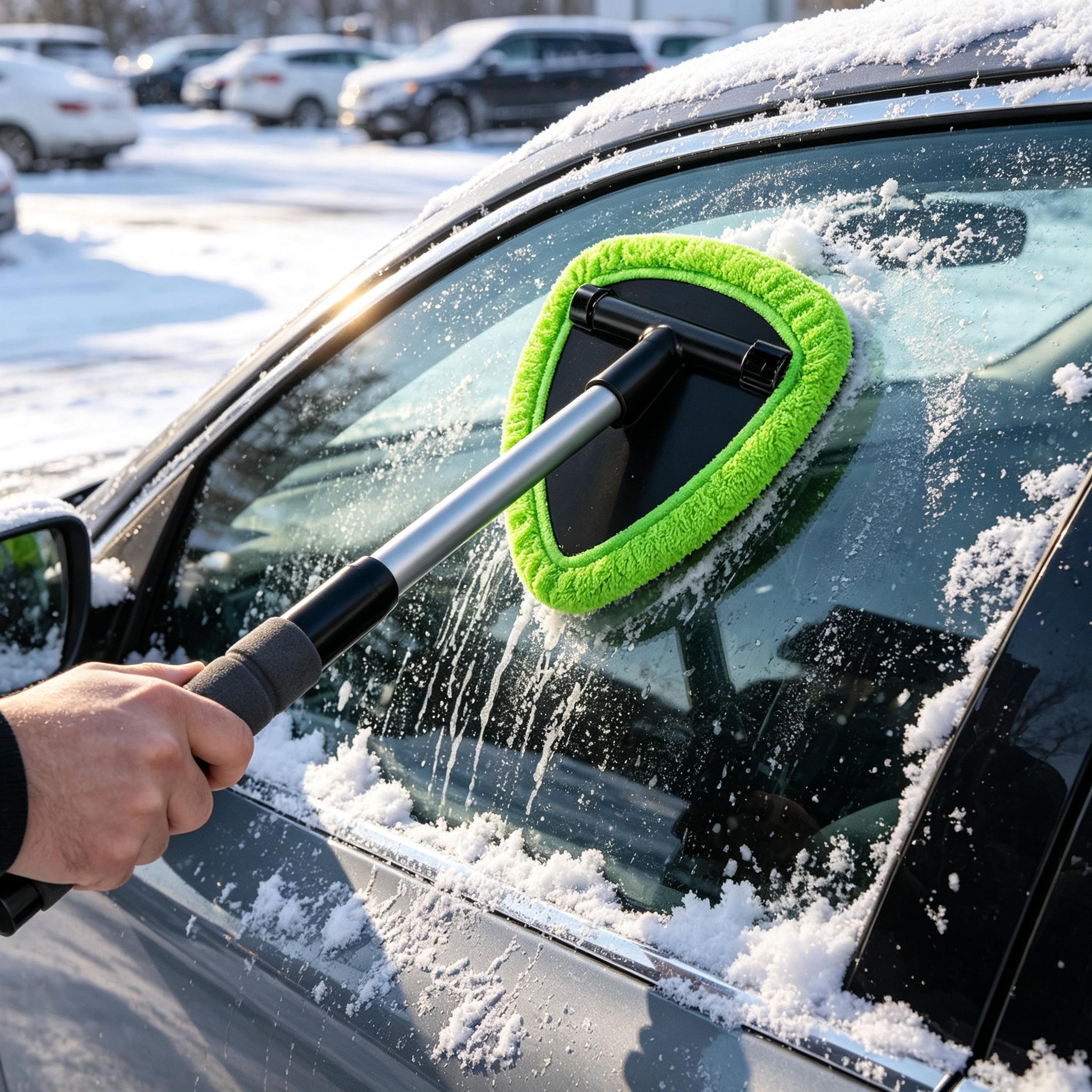
This is a windshield cleaning brush kit. What you get:
One extendable pole. Silver aluminum shaft with a twist-lock grip, foam-covered non-slip handle at the bottom.
One triangular cleaning head. Bright green microfiber looped cover over a black T-connector that swivels.
Five green microfiber replacement covers. Washable.
One transparent spray bottle.
The triangle is the point. A rectangle head leaves two untouchable wedges next to the A-pillars. A circle cannot work the corner seam. A triangle — three flat sides and a sharp corner — is the only geometry that fits the inside triangle formed by the glass, the A-pillar, and the roof headliner.
6. Six real jobs
Job 1 — The inside of the windshield
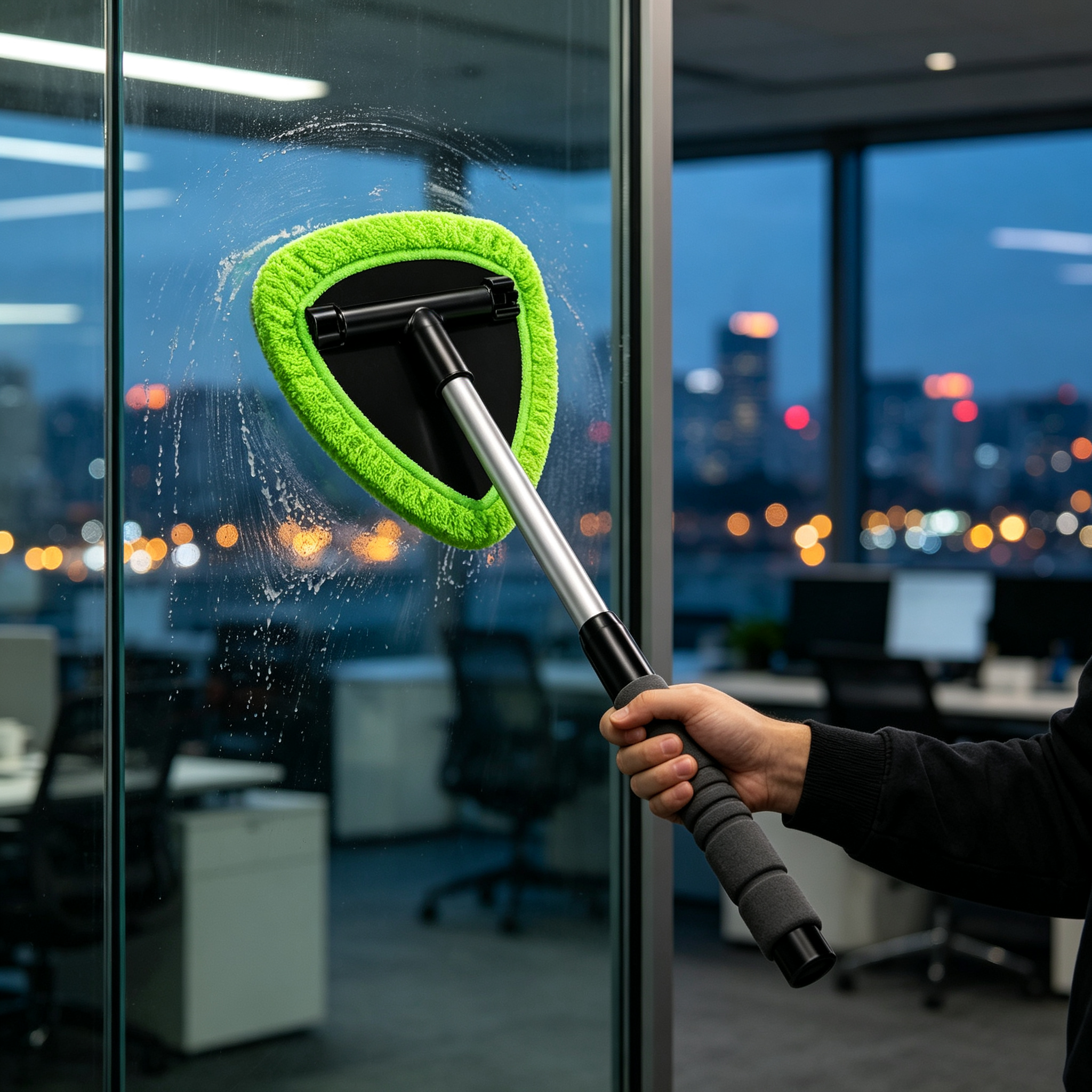
This is the main event. Lock the pole to the length that lets you sit normally in the driver's seat, spray two spritzes of plain water onto the green cover, and sweep from the passenger side. The triangular corner digs into the upper wedge. Three passes and the glass is clear.
Job 2 — Home windows
Open the casement, stand inside, and run the pole across the outside pane you cannot otherwise reach without a ladder. Second-floor bedroom windows? No ladder.
Job 3 — Bathroom mirrors
No more leaning across the vanity, no more spraying the faucet. Extend, damp-wipe, the long handle reaches the top edge of a 60-inch vanity mirror without you stretching.
Job 4 — TV screens and monitors
Use a dry cover. The microfiber's split fibers lift dust without touching the anti-glare coating. No Windex, no paper.
Job 5 — Shower glass doors
Damp cover, a couple of passes, squeegee-free drying. Streak-free because the microfiber does not shed lint.
Job 6 — Car side windows, rear hatch
Reach the outside of the rear tailgate glass of an SUV without opening the liftgate. Reach the inside of the quarter window behind the B-pillar that no rag can fit.
7. Why microfiber, why washable, why five covers
Standard cotton cloths push dirt around. Paper towels scratch. Disposable wipes are a landfill event and leave a surfactant film.
Microfiber is a blend of polyester and polyamide fibers split to a tenth of a human hair. CleanHome360's 2025 guide describes the standard two-step: damp microfiber to lift oils and fingerprints, followed by a dry microfiber to polish. The fibers grab dust electrostatically and hold it until you rinse.
Five covers means:
One for the car windshield.
One for home windows.
One for the bathroom mirror.
One for screens and TV.
One in reserve.
When one gets grimy, toss it in the washing machine with your towels. No fabric softener, air dry. It comes back like new. The five-pack eliminates the "wait for laundry" bottleneck that kills every other cleaning tool in your closet.
8. The ergonomics
The pole extends with a simple twist — counter-clockwise to loosen, pull to length, clockwise to lock. The bottom handle is foam, ribbed, with a hanging hole so you can store it on a hook in the garage or under the sink.
The head swivels. This matters. A rigid head on a sloped windshield either digs in on one corner or skips across the other. The swivel keeps the whole triangle flat against the glass at any angle.
Weight: under 400 grams fully extended. You will not notice your arm tiring after two minutes on the windshield.
9. What it saves you
A detailer visit: $40–$80. Twice a year minimum. That is $80–$160 annually.
A bottle of glass cleaner every other month at $5: $30 a year.
Paper towels, two rolls a month at $1.50: $36 a year.
A ladder for second-floor windows: the ER visit you never wanted.
The kit pays for itself the first Saturday you use it.
10. Eight things to check before you buy any windshield brush
Triangular head, not rectangular or round. The corner wedge is the whole point.
Swivel head, not rigid. Rigid leaves gaps on sloped glass.
Twist-lock aluminum pole, not flimsy plastic. Plastic telescoping poles wobble.
Foam grip. Cold mornings in the driveway matter.
At least three washable covers. You need one per surface.
A spray bottle included. Buying one separately is a hassle.
Microfiber, not chenille or cotton. Chenille holds too much water and streaks.
A hanging hole. Otherwise it lives under the seat forever.
This kit ticks all eight.
11. Before and after: a Sunday morning in October
Before. You wake up at 9. Sun streams in low. The car is parked facing east. You open the door, look through the windshield, and see a smear across the passenger side that looks like a child's handprint from August. You grab a Windex bottle and a roll of paper towels. You spray. You wipe. The smear smears. You wipe again. Now the windshield has a clean smear on top of a foggy film. You give up. You drive to Starbucks wearing sunglasses indoors.
After. You walk to the garage, pull the green brush off the hook, twist the pole open, spray two spritzes of water on the cover, lean in through the open driver's door, and sweep the triangle across the upper corner. Forty-five seconds. You flip the cover to the dry side and polish. Another thirty seconds. You put the brush back on the hook. The windshield is clear enough that you can see the red oak leaves across the street without sunglasses.
12. The bigger trend
American cleaning is in the middle of a quiet shift away from disposable sprays and paper. The numbers make it obvious: microfiber is growing faster than the overall cleaning category, and the automotive segment is the second-fastest vertical after household work. Detailers on TikTok and YouTube have spent the last three years demonstrating the same thing — water, microfiber, a pole, and a swivel head beat any chemical.
A windshield brush is not a gadget. It is the second half of that routine that nobody sold you. You already own the microfiber cloths. You already own the spray. What you did not own was the handle.
13. Who this is for
For the five-foot-four commuter in a high-roof SUV. For the mom who drives the kids to school and noticed the smear. For the detailer on the side who needs a backup tool in the kit. For the retiree who no longer wants to climb a ladder for second-floor windows. For the new-owner of a Model Y who was told the glass self-cleans and discovered it does not. For the truck owner who deals with bug splatter and winter road salt.
In every one of those hands, this tool does the same thing. It extends your arm by two feet. It fits the triangle you could not reach. It lifts the film. It leaves the glass the way it was designed to be seen through — clear, quiet, streak-free.
That is all. It is a pole, a triangle, and five washable green covers. But for the four-inch smear that ruins your morning, it is the only tool that actually fixes it.



