


Walk into any American kitchen on a Saturday afternoon. You will find it on the front of the new toaster you unboxed last week. On the inside of the kitchen window where a Christmas decal refused to let go in January. On the rear corner of the minivan's back window, where a high-school graduation bumper sticker has been peeling since May. On the glass-ceramic cooktop, where a pot of spaghetti sauce boiled over in March and left a caramelized ring that no amount of spray will touch. On the rental apartment wall, where a Command Strip hook held a picture for three years and left a rectangle of yellowed adhesive.
It is adhesive residue. And it is everywhere.
The numbers say as much. According to Global Info Research, the global adhesive removers market was valued at US$2.27 billion in 2024** and is projected to reach **US$3.14 billion by 2031, growing at a CAGR of 4.7%. The narrower tape remover market is even hotter: US$725.24 million in 2025, on track to hit US$1.06 billion by 2032 at a 5.6% CAGR. The glue stripper market grows at 6.5% CAGR, from US$479 million in 2025 to US$900 million by 2035, with North America alone worth US$820 million in 2024, climbing to US$1.16 billion by 2035. The sticker and vinyl remover segment — the tool category this product lives in — is growing at 6.8% CAGR through 2030, past US$1.2 billion.
On Amazon US, Goo Gone alone moved 47,000 units across 6 ASINs in July 2026, accounting for 71.2% of the top-10 adhesive remover volume. That tells you how big the liquid-remover category is. But here's the quiet shift: more and more of those Goo Gone spray bottles are being bought alongside a plastic scraper, not instead of one. Americans are learning that the fastest, safest, cheapest way to lift a sticker isn't a chemical at all — it's a sharp but soft blade.
1. The sticky problem Americans don't talk about
Walk into any American kitchen on a Saturday afternoon. You will find it on the front of the new toaster you unboxed last week. On the inside of the kitchen window where a Christmas decal refused to let go in January. On the rear corner of the minivan's back window, where a high-school graduation bumper sticker has been peeling since May. On the glass-ceramic cooktop, where a pot of spaghetti sauce boiled over in March and left a caramelized ring that no amount of spray will touch. On the rental apartment wall, where a Command Strip hook held a picture for three years and left a rectangle of yellowed adhesive.
It is adhesive residue. And it is everywhere.
The numbers say as much. According to Global Info Research, the global adhesive removers market was valued at US$2.27 billion in 2024** and is projected to reach **US$3.14 billion by 2031, growing at a CAGR of 4.7%. The narrower tape remover market is even hotter: US$725.24 million in 2025, on track to hit US$1.06 billion by 2032 at a 5.6% CAGR. The glue stripper market grows at 6.5% CAGR, from US$479 million in 2025 to US$900 million by 2035, with North America alone worth US$820 million in 2024, climbing to US$1.16 billion by 2035. The sticker and vinyl remover segment — the tool category this product lives in — is growing at 6.8% CAGR through 2030, past US$1.2 billion.
On Amazon US, Goo Gone alone moved 47,000 units across 6 ASINs in July 2026, accounting for 71.2% of the top-10 adhesive remover volume. That tells you how big the liquid-remover category is. But here's the quiet shift: more and more of those Goo Gone spray bottles are being bought alongside a plastic scraper, not instead of one. Americans are learning that the fastest, safest, cheapest way to lift a sticker isn't a chemical at all — it's a sharp but soft blade.
2. Why chemicals alone fall short
Aerosol adhesive removers work. We know they work. Goo Gone, Goof Off, Un-Du, Unisolve — these are household names for a reason. But they have three real problems that every American DIYer runs into.
They smell. Open a can of Goo Gone in a closed kitchen and the whole house smells like citrus solvent for an hour. You have to ventilate. You can't use it around kids, pets, or a baby crawling on the kitchen floor.
They leave their own residue. The solvent softens the glue, but it also leaves an oily film that you then have to wash off with dish soap. On a glass cooktop, that means two extra steps. On car window tint, it can leave streaks.
They can't lift a thick sticker. A 5-year-old bumper sticker, a vinyl decal, a protective film on a new appliance — the glue is only half the battle. You still have to get a blade under the edge and peel it up.
That's where the plastic razor scraper comes in. It doesn't try to dissolve the glue. It mechanically gets under the sticker and lifts it. And because the blade is plastic, not steel, it does something a metal razor never safely can: it glides across glass, ceramic, acrylic, and painted surfaces without leaving a scratch.
3. The problem with the metal razor blade
Most Americans have tried the obvious fix. They grab a utility knife, a box cutter, or a metal razor blade from the garage. And for about ten seconds, it works. Then they notice they've just put a 2-inch scratch across the glass-ceramic cooktop. Or across the tinted car window. Or across the acrylic shower door.
The manufacturers know this. SCHOTT CERAN, the world's largest maker of glass-ceramic cooktop panels, in its official care instructions explicitly warns homeowners that a dull or nicked metal blade can damage the cooktop surface, and recommends a scraper held at roughly a 30° angle. LG, in its cooktop cleaning documentation, warns against using a metal razor scraper in a way that damages the printed markings on the glass. Home Depot's own cooktop maintenance guide recommends a razor scraper — but it assumes a sharp, clean blade used correctly.
Here's the problem: most homeowners don't hold a razor at exactly 30°. They push hard. They use a dull blade. They scrape the window tint they're trying to preserve. The result is a permanent scratch on a surface that costs hundreds or thousands of dollars to replace.
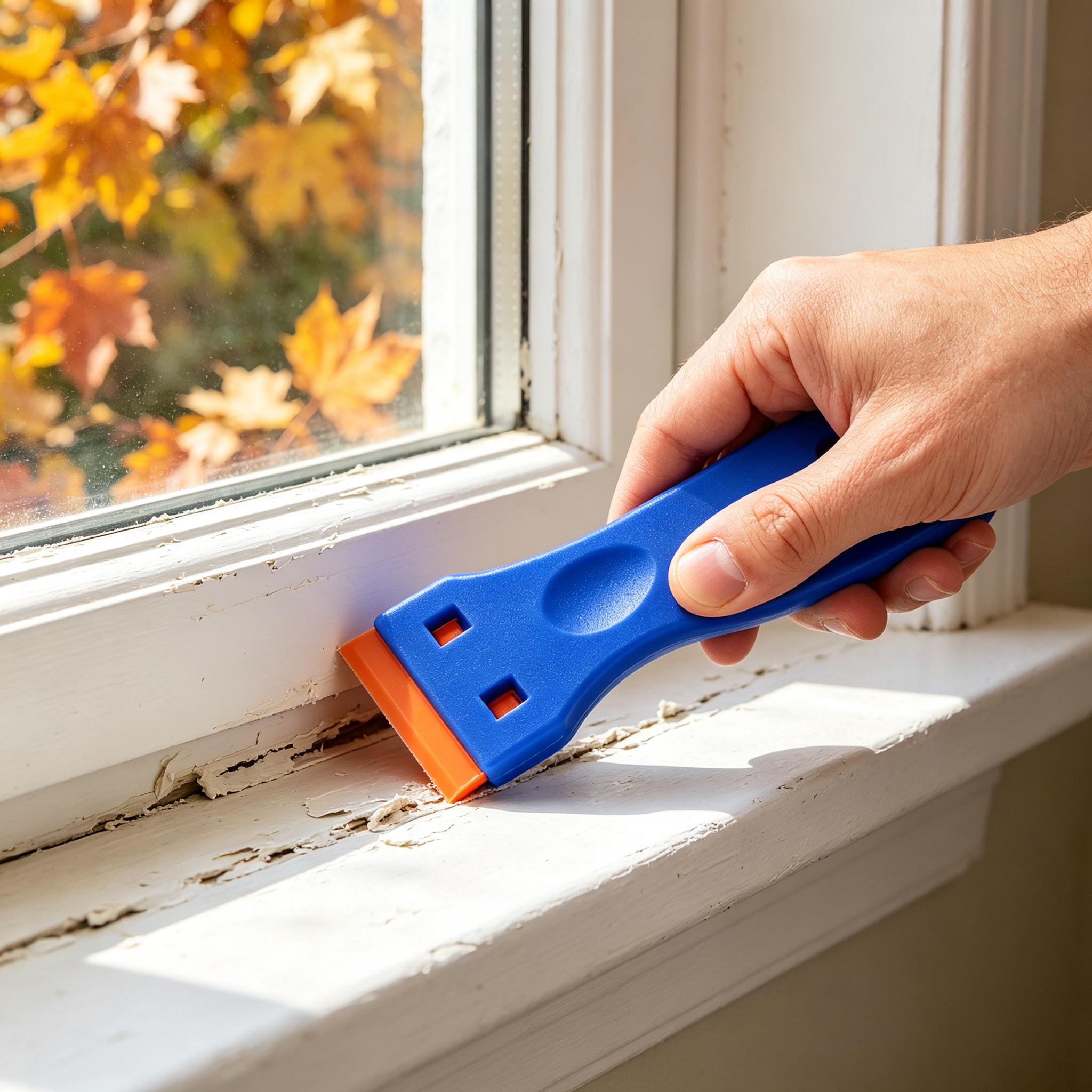
The plastic scraper solves this by trading a little sharpness for a lot of forgiveness. A plastic blade is hard enough to shear through cured adhesive and vinyl, but soft enough to flex and slide over glass, enamel, and acrylic without biting in. You can press as hard as you want. You can scrape at a bad angle. The blade is the sacrificial part — if it nicks, you flip it or swap it for one of the 20 replacements, not the cooktop.
4. Where Americans actually use this tool: six real scenarios
Scenario A — The new-appliance price sticker
You just unboxed a new Instant Pot, a new Ninja air fryer, a new Vitamix. The manufacturer's sticker on the front is a 3-inch rectangle of heavy paper with a barcode, a price, and a warning. It peels halfway and leaves a glue ghost. Spray it with Goo Gone? Smell it out for an hour. Heat it with a hair dryer? Takes ten minutes. A plastic scraper at 30° lifts the whole sticker and the residue in 30 seconds.
Scenario B — The car window
This is the single biggest use case. The US automotive adhesive remover market was US$370 million in 2025** and is projected to hit **US$651 million by 2035 at a 5.8% CAGR. The window-tint removal market was worth about **US$2.22 billion in 2025**, 58.4% of it automotive. Professional tint removal runs **US$150–$300 per car, and US$300–$450 for a full job**. DIY removal, using a heat gun and a plastic scraper, costs US$20–$100 in supplies and saves the rest. California's Vehicle Code now requires at least 70% VLT on front side windows, which has driven a 22% year-over-year increase in tint-removal requests — a lot of those cars are being done in driveways, not shops.
A plastic blade is the only safe choice on tinted glass. A metal razor will cut the tint film you're trying to peel off.
Scenario C — The glass-ceramic cooktop
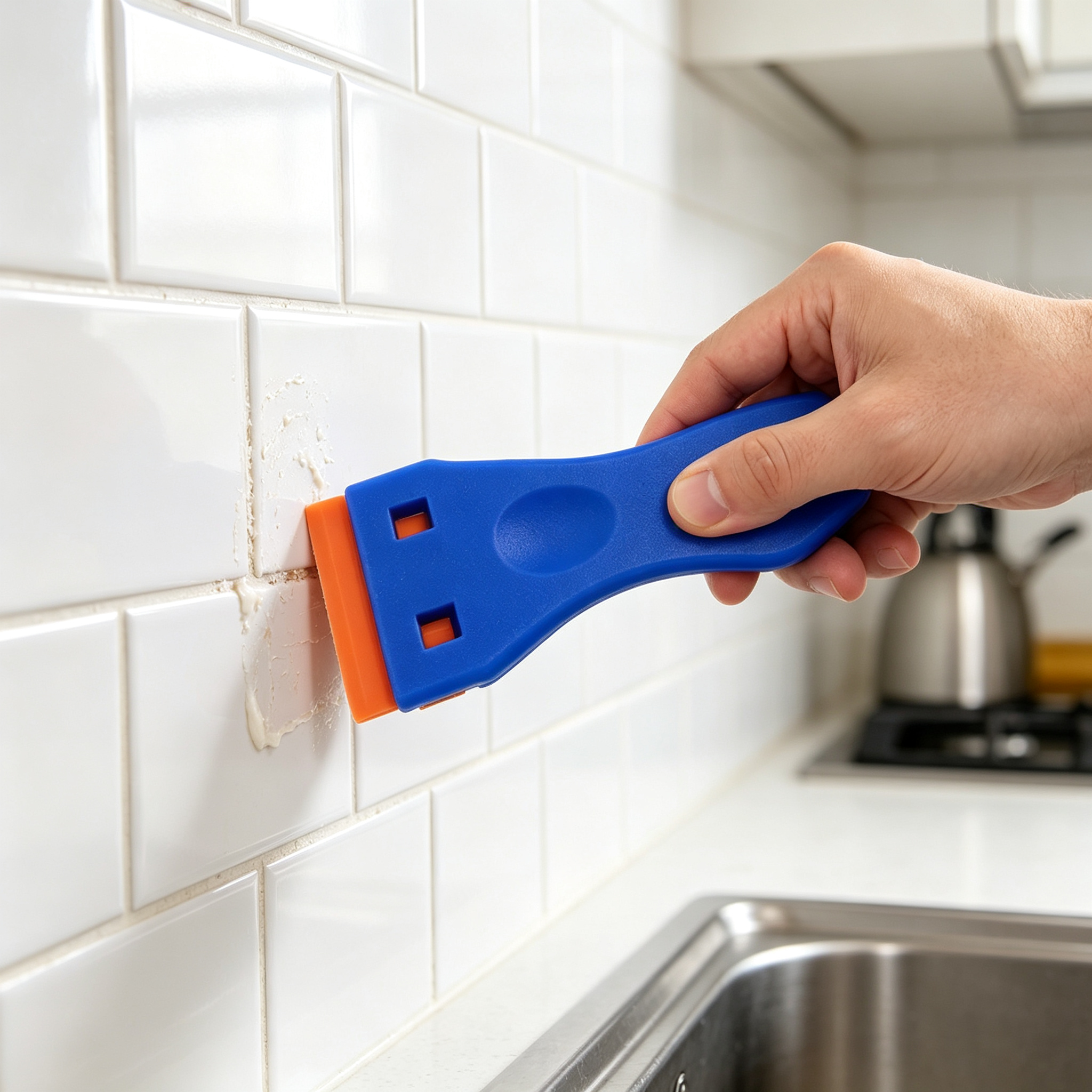
Americans bought millions of smooth-top electric and induction ranges in the last decade. Boiled-over milk, melted cheese, burnt pasta sauce — these carbonize onto the glass. A sponge does nothing. A Brillo pad scratches the surface. The official manufacturer recommendation (SCHOTT, Home Depot, LG) is a razor scraper held at a 30° angle. A plastic version does the same job with zero risk to the printed markings.
Scenario D — The rental move-out
In the US, renters lose security deposits over walls. A Command Strip that held a wall clock for two years leaves a rectangle of adhesive on painted drywall. A plastic scraper, used gently, lifts the strip residue without gouging the paint. It also works on vinyl flooring, on tile grout haze, on the inside of the oven.
Scenario E — The craft room and the classroom
Teachers peel bulletin-board letters off cork boards and glass. Crafters remove vinyl from silicone mats. Signmakers lift transfer paper. Every school and maker space in America needs a box of these.
Scenario F — The RV, the boat, and the vinyl wrap
Vinyl decals on RVs and boats peel after a few years in the sun. A heat gun plus a plastic scraper is the professional's standard toolkit. A metal razor will scratch the gel coat.
5. Why the bundle matters: 2 scrapers + 20 blades
Walk down the cleaning aisle at Walmart or search "plastic razor scraper" on Amazon and you'll see the category has standardized on a bundle format. Walmart currently lists a 2-piece plastic razor scraper set with 100 double-edge plastic blades for about US$16.63. The unit you're looking at is a 2-scraper, 20-blade bundle — a slightly smaller but more affordable entry point.
The bundle structure matters for three reasons.
Two scrapers mean two surfaces. Keep one in the kitchen drawer for the cooktop and counter. Keep the other in the garage or car trunk for window and decal work. You're not dragging the kitchen tool out to the driveway.
Twenty blades mean a year of work. Each plastic blade is good for maybe 5–10 jobs before it dulls or chips. Twenty blades is two scrapers × a year of household use. When a blade nicks, you flip it, use the other edge, then swap it out. You never scrape with a damaged blade — which is the single biggest cause of surface scratching.
The handle is the tool; the blade is disposable. The ergonomic blue plastic handle with a hanging hole lasts for years. The orange blades are the consumable. When you finally run out, you buy a 100-pack of replacement blades for under US$10.
6. What's in the hand: the ergonomics
Pick up the scraper. It weighs about 40 grams. It's molded in blue polypropylene, with a palm-sized oval grip indentation, a hanging hole at the top, and a blade slot at the bottom that holds the orange plastic blade with a simple snap. You can change a blade in 10 seconds: push the old one out from the side slot, slide a new one in.
The geometry is deliberate. The handle is slightly angled so that when you hold it naturally, the blade sits at roughly 30° to the surface — the exact angle SCHOTT and Home Depot recommend. You don't have to think about it. Your hand naturally holds it right.
The hanging hole matters. Americans have a junk drawer, but the good tools live on a hook in the garage, on a pegboard, or in a caddy under the sink. A hanging hole means it's where you left it, not buried under sponges.
7. The math: what this tool saves you
A professional window tint removal on one car is US$150–$300. A professional cooktop cleaning is US$80–$150. Goo Gone at US$6–$8 a bottle, used every month, is US$80 a year. A professional move-out clean is US$200–$400.
This scraper set costs less than a single Goo Gone bottle per year of use. It doesn't smell. It doesn't leave residue. It doesn't require gloves or ventilation. It doesn't expire.
For a renter facing a security deposit of US$1,000–$2,000, a US$12–$15 scraper set that removes Command Strip residue without gouging paint is the cheapest insurance you can buy.
For a car owner facing a US$200 tint-removal bill, the same set, paired with a hair dryer or heat gun, handles the whole job in a driveway on a Saturday.
For a homeowner with a glass cooktop, it's the difference between a sparkling surface at dinner time and a permanent brown ring under the kettle.
8. The eight things to look for before you buy
Plastic blades, not metal. If the listing shows a steel blade, keep shopping. Steel scratches glass-ceramic, tint, and acrylic.
Replacement blades included. A scraper without spare blades is a dead tool in two months. Twenty is the right number.
Double-edged blade. Both sides of the orange blade are sharp. Flip it instead of throwing it away.
Ergonomic grip. An oval palm indentation means you can press hard for 10 minutes without cramping.
Hanging hole. You want it on a hook, not in a drawer.
Lightweight handle. If it weighs more than 60 grams, it's overbuilt and tiring.
Safe on glass. The listing should explicitly say "scratch-free" or "safe for glass, ceramic, acrylic."
A second scraper in the box. One lives in the kitchen, one lives in the garage.
9. Before and after: a Saturday in a typical American kitchen
Before. It's 10 a.m. Saturday. You've got family coming for Sunday dinner. You look at the glass cooktop and see the ring from the chili you burned on Tuesday. You look at the kitchen window and see the outline of last Christmas's window clings. You look at the new air fryer on the counter and the manufacturer sticker still on the front. You grab a sponge and a bottle of all-purpose spray, spray the cooktop, wait, scrub — the brown ring doesn't move. You grab a metal spatula and start scraping, then stop when you see a faint scratch. You decide to leave it. Sunday. Your brother-in-law leans against the counter and says, "You should probably get that cooktop cleaned." You nod.
After. It's 10 a.m. Saturday. You open the junk drawer, take out the blue plastic scraper, pick the orange blade out of the box. You pass the cooktop at 30° once. The burnt ring peels up in a single curl. Thirty seconds. You walk to the window, lift the edge of the old cling, and the whole sheet comes off in your hand. Twenty seconds. You flip the appliance sticker up at the corner, slide the blade under, and it lifts off the front of the air fryer without a ghost. Fifteen seconds. You rinse the blade under the tap, hang the scraper on its hook, and go make coffee. Sunday. Nobody says a word.
10. The larger trend: Americans are re-learning mechanical cleaning
There is a quiet shift happening in American cleaning culture. For 20 years, the answer to every household problem was a spray: citrus spray, foaming spray, antibacterial spray. During COVID, Americans bought more spray bottles than at any point in history.
Now the pendulum is swinging back. People are reading labels. They don't want chemicals around kids, pets, and food. They're buying washable microfiber cloths instead of paper towels. They're buying silicone baking mats instead of parchment. They're buying refill stations instead of single-use bottles.
The plastic scraper is part of that trend. It's a mechanical tool. It does one job — lift a sticker — without a chemical, without a smell, without an expiration date. It lives in a drawer for five years. When the blade dulls, you swap a 5-cent blade, not the whole tool. It's the opposite of a single-use cleaning product.
11. Who this is for, finally
This is for the new homeowner who just unboxed a house of appliances and a counter of price stickers. It's for the parent with a minivan covered in soccer-team decals that need to come off before resale. It's for the renter who wants the full security deposit back. It's for the car enthusiast debadging a tailgate. It's for the teacher peeling bulletin board letters off a glass door. It's for the grandparent whose grandkids put stickers on every window. It's for the RVer who's been living with faded vinyl for three summers. It's for the home baker who keeps burning milk onto the induction cooktop.
In every one of those hands, the tool does the same thing: it slides under the glue, lifts it up, and leaves the surface underneath exactly as it was — clear, smooth, and un-scratched.
That's the whole pitch. It isn't a new invention. It's a 50-cent plastic blade on a 40-gram ergonomic handle. But in a country where Goo Gone sells 47,000 units a month, where tint removal is a US$2.2 billion industry, and where glass cooktops are now in most modern kitchens, the tool that lifts residue without chemicals and without scratches isn't a luxury. It's the missing half of the cleaning caddy.



