


It is 9:47 on a Tuesday. The dinner plates are stacked by the faucet. You cooked: a cast-iron skillet with seared salmon skin, a stainless stockpot that boiled the pasta, a non-stick pan that held the scrambled eggs, and a baking sheet that caught the roasted broccoli.
You fill the sink with hot water, pump in the dish soap, and reach for the yellow sponge.
By the third plate, your fingers are pruned. By the stockpot, your knuckles are scraping the bottom. By the baking sheet, you are already thinking about the sponge smell — that sour, mildew smell that every American kitchen knows by Wednesday.
This is the moment the flower-shaped brush was built for.
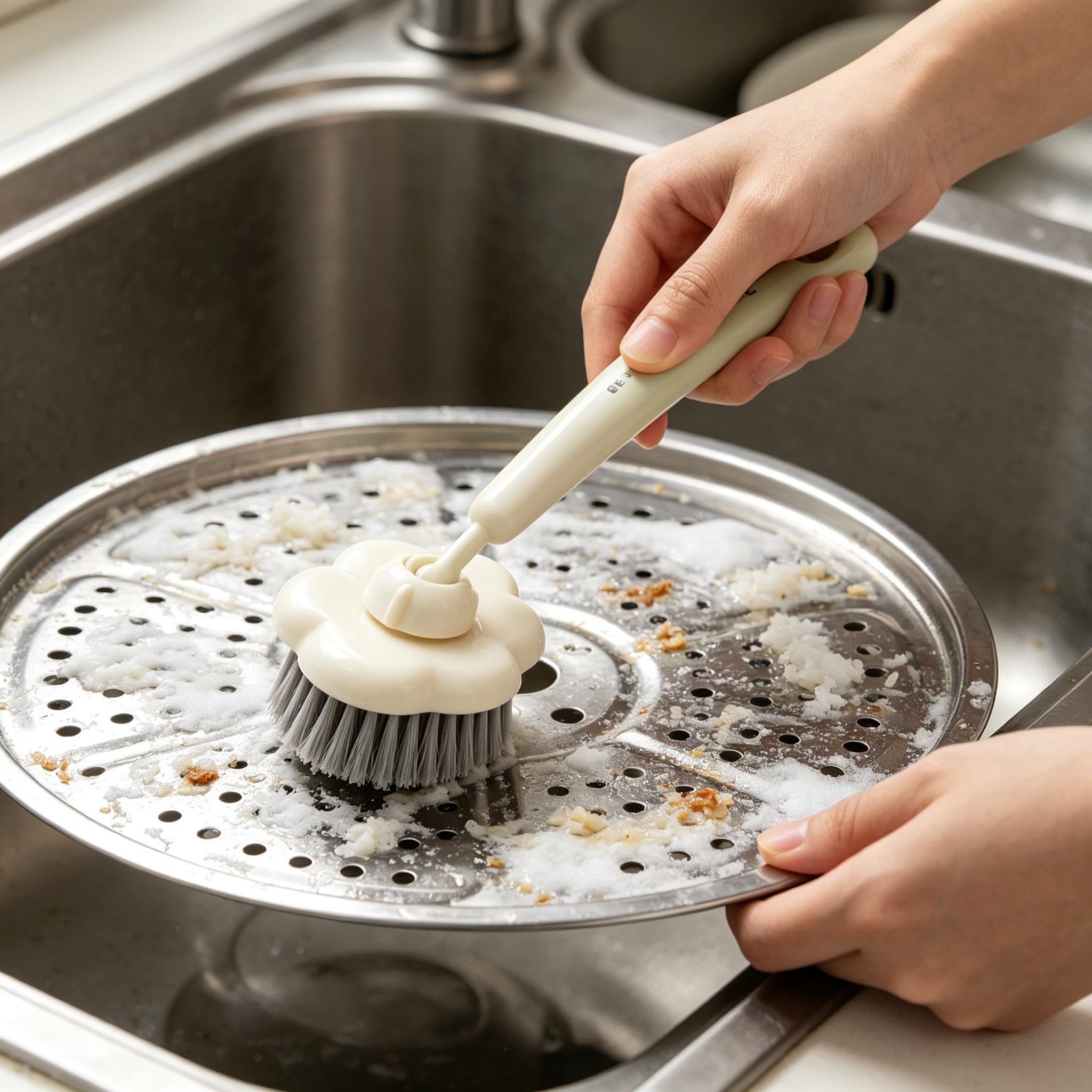
1. The sink at 9:47 PM
It is 9:47 on a Tuesday. The dinner plates are stacked by the faucet. You cooked: a cast-iron skillet with seared salmon skin, a stainless stockpot that boiled the pasta, a non-stick pan that held the scrambled eggs, and a baking sheet that caught the roasted broccoli.
You fill the sink with hot water, pump in the dish soap, and reach for the yellow sponge.
By the third plate, your fingers are pruned. By the stockpot, your knuckles are scraping the bottom. By the baking sheet, you are already thinking about the sponge smell — that sour, mildew smell that every American kitchen knows by Wednesday.
This is the moment the flower-shaped brush was built for.
2. Why the sponge is the wrong tool
The Scotch-Brite sponge has been on the American kitchen counter since 1958. 3M still sells it by the billion. The current Scotch-Brite Heavy Duty Scrub Sponge advertises "flexible, durable, strong" and "sanitize up to 20X in the dishwasher." The Greener Clean line brags about 100% recycled scrubbing fibers. Scrub Daddy built a nine-figure business on a smiley face that softens in warm water.
But every American cook who has ever owned a non-stick pan knows the three quiet failures of the sponge:
It holds water. A kitchen sponge stays wet for hours. That wetness is a bacteria farm. USDA studies over the years have found kitchen sponges to be among the dirtiest surfaces in the home.
It scratches non-stick. Even "non-scratch" Scotch-Brite pads wear through the Teflon coating over months. Once the coating is gone, the pan is gone.
It puts your hands in the water. The long handle is missing. Your fingers are submerged in hot, soapy water for ten minutes a night. Dermatologists call it "wet work": hands in water or gloves on for more than two hours a day, or more than twenty hand washes, is the clinical definition. For a home cook, a parent, a line cook at a weekend brunch spot, this is the everyday cause of dishpan hands, cracked cuticles, and hand eczema.
The chainmail scrubber — the stainless-steel ring mat that Oh So Spotless names "Best for Cast Iron Pots" in its 2026 roundup — solves cast iron but is useless on a non-stick egg pan. Steel wool rusts. Brillo pads leave metal streaks.
The market has converged on a fourth answer: a long-handle brush with soft PET bristles and a swiveling head. This product is that answer, in a flower shape, in sage green.
3. What's in the box
A long, rounded handle in soft sage green, with the words "BE HAPPY EVERY DAY" printed vertically and a flower-shaped hanging hole at the top.
A flower-shaped head — six rounded petals — on a 360° swivel joint.
Dense gray PET bristles that flex but do not scratch.
A matching cream-white variant for kitchens that lean warm neutral.
Retail box in cream and sage, with "FLOWER POT BRUSH / Clean Hands Clean Home" printed on the front.
The flower shape is not decoration. It is geometry. A round brush head leaves a circular dead zone at the corner of a square pan. A rectangular head cannot reach the curved bottom of a wok. A six-petal flower flexes around corners, sits flat on a flat bottom, and hugs the curve of a pot wall.
The 360° swivel joint is the second idea. A rigid brush head forces you to angle your wrist to keep the bristles flat on the pan. The swivel lets the head follow the pan while your wrist stays neutral. That is why the product photo shows the head tilted at a 45° angle against a non-stick skillet.
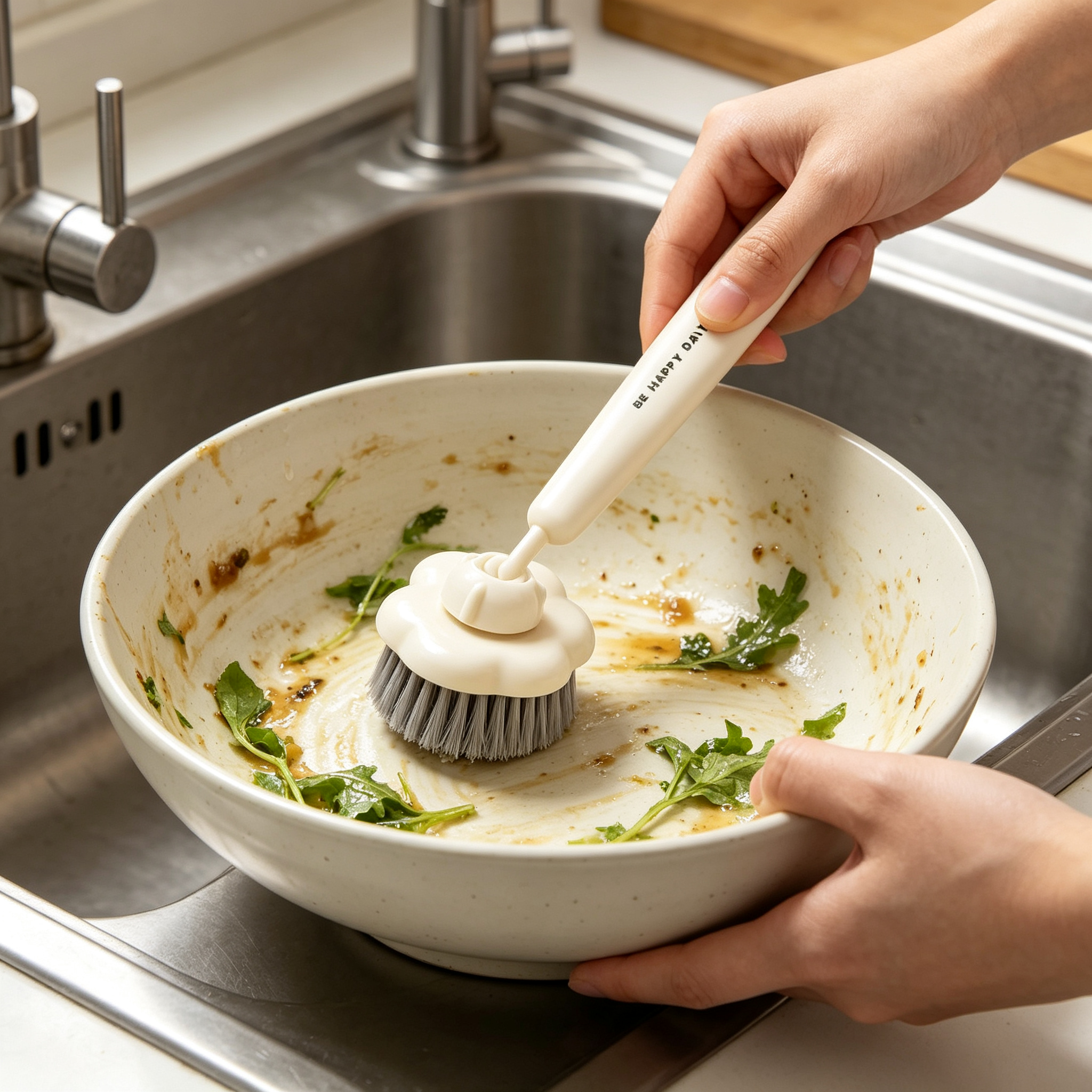
4. Six real jobs
Job 1 — The non-stick egg pan
Warm water, one pump of soap, two passes. The PET bristles lift the cooked-on egg without scratching. The long handle keeps your knuckles out of the water.
Job 2 — The deep stockpot
Fill the pot with warm soapy water, drop the brush in, and reach the bottom without leaning over the sink. The swivel head hugs the curve where the bottom meets the wall — the exact spot where starchy pasta water dries into a film.
Job 3 — The cast-iron skillet
After a cast-iron dinner, you rinse with hot water and scrub. The flower head reaches the curved walls of a Lodge skillet without your fingers touching the rust-prone iron. (For the really baked-on stuff, you still want chainmail — but for weekly upkeep, this is enough.)
Job 4 — The grill pan / baking sheet
Ridged grill pans are the sponge's worst enemy. A flat sponge bridges the ridges and leaves the valleys untouched. The flower bristles splay into the grooves and lift the burnt-on grease.
Job 5 — The kitchen sink itself
After the dishes are done, flip the brush and scrub the sink walls and the drain rim. The swivel head gets into the corner where the sink wall meets the bottom — the place where gunk grows.
Job 6 — The countertop and stovetop
A quick pass on the quartz counter or the glass stovetop after dinner. The soft bristles do not scratch, and the long handle means you are not leaning over the stove.
5. Why PET bristles, why long handle
PET (polyethylene terephthalate) bristles are the middle ground between steel wool and a sponge. They are stiff enough to lift grease, soft enough not to scratch non-stick, and they rinse clean — no food trapped in a porous foam.
The long handle is the ergonomic argument. Wayfair's product listings describe it plainly: "the long-handle dish brush features a sturdy, ergonomic handle that keeps your hands away from hot water and harsh cleaning chemicals." The AliExpress buying guide adds: "a long handle allows me to clean without bending, reaching, or straining — especially important when dealing with large stockpots."
The hanging hole closes the loop. Wet brushes grow mildew if they sit in a puddle. Hang it on a hook by the sink, and the bristles dry overnight.
6. The cost math
A sponge pack: $4 for three, replaced every 2–4 weeks. That is $50–$80 a year.
Scrub Daddy: $5 each, replaced every 8 weeks. $30 a year.
A bottle of dish soap: $4 every six weeks. $35 a year.
A bottle of hand lotion for the cracked skin: $12 every other month. $72 a year.
A new non-stick pan after the sponge scratched it: $40–$80 every two years. $20–$40 a year.
This brush costs less than a year of sponges. It lasts years.
7. Eight things to check before buying any dish brush
Long handle, not a palm brush. Palm brushes put your hands back in the water.
Swiveling head, not rigid. Rigid heads force wrist angle.
PET or nylon bristles, not steel wool. Steel wool scratches non-stick and rusts.
Hanging hole. Wet brushes mildew.
Dense but soft bristles. Stiff enough for grease, soft enough for coating.
Comfortable grip. You will hold it for ten minutes a night.
Replaceable head, ideally. When the bristles wear, replace the head, not the whole brush.
A color you want to leave on the counter. Sage green, cream, soft pastels — because you will leave it on the counter.
8. Before / after: a Wednesday night
Before. 9:47 PM. You fill the sink. The yellow sponge smells faintly sour. You wash the cast iron first — the chainmail clinks. Then the non-stick pan — and you can feel the sponge catching on a micro-scratch you know you put there last month. By the time you finish the baking sheet, your knuckles are red and your cuticles are tight. You pump lotion on. You go to bed.
After. 9:47 PM. You fill the sink. You pick up the sage-green flower brush. Two passes on the egg pan. Three swipes around the stockpot bottom. The swivel head hugs the grill pan ridges. You rinse the brush under the tap, shake it, hang it on the hook by the sink. Your hands are dry. You pump lotion once, out of habit, and notice you do not need to.
9. The big trend
American kitchens in 2026 are moving away from disposable. Scotch-Brite itself now sells "Greener Clean" with 100% recycled fibers. Scrub Daddy launched a dye-free Scrub Mommy for households that want "a simpler, cleaner option." The Etsy and TikTok aesthetic has settled on sage green, cream, and soft terracotta. Cast iron is back — Lodge sold out through the pandemic and never really stopped. People are cooking at home again, and they want the tools on the counter to look like the rest of the kitchen.
A flower-shaped, sage-green, long-handle dish brush is exactly that trend in plastic and PET.
10. Who this is for
For the home cook who owns a non-stick pan and a cast iron skillet. For the parent who does dishes after the kids are asleep. For the renter with a small sink and no dishwasher. For the retiree whose wrists no longer angle well. For the person whose kitchen aesthetic is "quiet luxury" and does not want a neon-yellow sponge on the counter. For the brunch regular who cooks Saturday breakfast for four.
In every one of those hands, the tool does the same thing. It keeps your knuckles out of the hot water. It swivels around the pan corner. It lifts the egg without scratching the coating. It hangs dry overnight.
That is all. A long handle, a flower, and gray PET bristles. But for the 9:47 PM sink, it is the right tool.



