


Walk into a typical American home. Look up. There is a ceiling fan spinning slowly overhead, a smoke detector mounted on the vaulted ceiling, a pair of vertical blinds covering the sliding glass door, and a wooden bookshelf reaching toward the second-floor loft. Now look closer at the top edge of the kitchen cabinets, the crown molding along the hallway, and the chandelier hanging over the dining table.
There is dust on all of it.
The American Lung Association estimates that roughly four out of five U.S. homes have detectable levels of dust mite matter in at least one bed. More than 50 million Americans suffer from indoor allergies, and another 24 million live with asthma — including more than 6 million children. Researchers link roughly 30% of asthma flare-ups and perennial rhinitis cases directly to dust exposure. If you let dust build up for just two weeks, the amount on flat surfaces jumps by more than 50%, and the particulate matter floating in the air climbs with it.
And yet, when the American Cleaning Institute asked Americans in 2025 which cleaning tasks they prioritize for health, dusting ranked near the bottom — only 22% of respondents listed it as a top habit. The reason is not laziness. It is frustration. Dusting is hard. The dust sits on top of the fan blades, on the third shelf of the bookshelf, on the ceiling 10 feet overhead, and between the slats of the blinds. To reach it, you need a ladder, a chair, a stepladder, or a husband willing to risk his lower back for a Sunday afternoon. It is no wonder that 80% of Americans report spring cleaning at least once a year — and only 27% deep-clean in winter, when the windows are shut and the furnace recirculates the same dusty air day after day.
This is the gap that the 2026 extendable microfiber duster was built to close.
1. The Quiet Epidemic Hiding Above Every American Living Room
Walk into a typical American home. Look up. There is a ceiling fan spinning slowly overhead, a smoke detector mounted on the vaulted ceiling, a pair of vertical blinds covering the sliding glass door, and a wooden bookshelf reaching toward the second-floor loft. Now look closer at the top edge of the kitchen cabinets, the crown molding along the hallway, and the chandelier hanging over the dining table.
There is dust on all of it.
The American Lung Association estimates that roughly four out of five U.S. homes have detectable levels of dust mite matter in at least one bed. More than 50 million Americans suffer from indoor allergies, and another 24 million live with asthma — including more than 6 million children. Researchers link roughly 30% of asthma flare-ups and perennial rhinitis cases directly to dust exposure. If you let dust build up for just two weeks, the amount on flat surfaces jumps by more than 50%, and the particulate matter floating in the air climbs with it.
And yet, when the American Cleaning Institute asked Americans in 2025 which cleaning tasks they prioritize for health, dusting ranked near the bottom — only 22% of respondents listed it as a top habit. The reason is not laziness. It is frustration. Dusting is hard. The dust sits on top of the fan blades, on the third shelf of the bookshelf, on the ceiling 10 feet overhead, and between the slats of the blinds. To reach it, you need a ladder, a chair, a stepladder, or a husband willing to risk his lower back for a Sunday afternoon. It is no wonder that 80% of Americans report spring cleaning at least once a year — and only 27% deep-clean in winter, when the windows are shut and the furnace recirculates the same dusty air day after day.
This is the gap that the 2026 extendable microfiber duster was built to close.
2. The Market Is Already Voting With Its Wallet
You can tell how seriously Americans take high-reach cleaning by looking at the numbers. The global cleaning tools market, according to Grand View Research, is projected to reach $78.6 billion by 2030**, growing at a 5.3% CAGR. Within that, the feather duster segment alone is expected to hit **$1.87 billion by 2034, and microfiber dusters already hold a 38.5% share of that category — the fastest-growing product type in the entire duster aisle.
The extendable fluffy duster sub-segment is growing even faster: a 6.8% CAGR from 2024 to 2030, pushing past $1.2 billion by 2030. The microfiber duster refill market — the replacement heads you buy after you own the handle — is a $1.2 billion business in 2025 and is forecast to reach $1.8 billion by 2034. That growth tells you something important: Americans are no longer treating dusters as a one-time purchase. They are buying the pole once, and then buying the washable, reusable microfiber heads again and again.
The United States surface cleaner market — a broader bucket that includes every spray, wipe, and wand used on home surfaces — is valued at $4.32 billion in 2025** and is projected to reach **$7.34 billion by 2032, an 8.18% CAGR. The U.S. dust-mite vacuum market, a related but distinct category for allergy sufferers, sits at $0.95 billion in 2025 and is growing 4.5% a year.
What this means for a consumer staring at the ceiling fan is straightforward: the tool you are about to buy is not a niche gadget. It is one of the fastest-growing segments in the entire $4 trillion U.S. home-improvement and household-goods economy.
3. Why American Homes Are Dust Magnets (and Why You Can't Just Vacuum It)
American homes are unusually well-designed for collecting dust at height.
First, ceilings are high. The average new American single-family home has 9-foot ceilings on the first floor, and many vaulted-ceiling living rooms push 10, 11, or 12 feet. Two-story foyers, cathedral ceilings over the great room, and lofts above the master bedroom are standard features in suburban construction from Florida to Washington.
Second, ceiling fans are everywhere. According to industry estimates, ceiling fans are installed in roughly 75% of new American homes, particularly in the South, the Midwest, and Southwest. Every spinning blade becomes a horizontal shelf for dust. A fan that has not been cleaned in six months will shed a visible cloud of dust the next time you turn it on low.
Third, windows are covered in blinds. Horizontal blinds, vertical blinds, plantation shutters, and wood blinds are in millions of homes because they filter light without blocking the view. Each slat is a horizontal shelf. A 2-foot by 4-foot window can have 40 slats — and wiping them by hand, one slat at a time, with a cloth draped over your fingers, takes roughly eight minutes per window.
Fourth, Americans decorate upward. Bookshelves go to the ceiling. Crown molding runs along every wall. Kitchen cabinets extend overhead. Chandeliers, pendant lights, and smoke detectors hang in the middle of rooms. The top of the refrigerator is used as storage. The top of the kitchen cabinets is used as storage. The top of the pantry is used as storage. Every flat surface above shoulder level becomes a horizontal dust-collection shelf.
Finally, Americans own pets. The APPA National Pet Owners Survey finds that roughly two-thirds of U.S. households own a pet — about 86.9 million homes. Dog dander, cat hair, and the fine particulate they shed circulate in the air and settle on every horizontal surface in the house.
A vacuum cleaner handles floors. It does not handle the top of the bookshelf. A feather duster pushes dust into the air. A microfiber duster with an extendable pole is the only tool that simultaneously reaches 7 feet overhead and traps the dust instead of moving it.
4. The Science of Why Microfiber Works Where Feathers Fail
A traditional ostrich feather duster — the kind you see in old movies — does not actually pick up dust. It lifts it into the air, where it floats for 30 to 60 minutes before settling back down on the same shelf you just cleaned. A dry rag pushed across a shelf leaves streaks and drives dust into the grain. A canister vacuum with the brush attachment works, but dragging a 15-pound vacuum up and down a stepladder to clean one fan blade is its own small adventure.
Microfiber is different. Each strand is a blend of polyester and polyamide, split into fibers roughly 1/160th the diameter of a human hair. When the fluffy microfiber head brushes across a surface, the fibers generate a mild static charge and act like a million tiny hooks. They grab dust, pollen, pet dander, and even fine particulate down to roughly 1 micron — the size of most household allergens. Once trapped, the dust stays in the fluffy head until you rinse it under the tap or toss it in the washing machine.
This is not marketing copy. It is why allergy and asthma publications consistently recommend washable microfiber dusters over feather or disposable options: the static holds the dust, and the wash closes the loop. You do not redistribute allergens into the air on the next pass.
5. The 2026 Extendable Microfiber Duster: Five Design Pillars
Pillar 1 — A Telescopic Pole That Actually Reaches
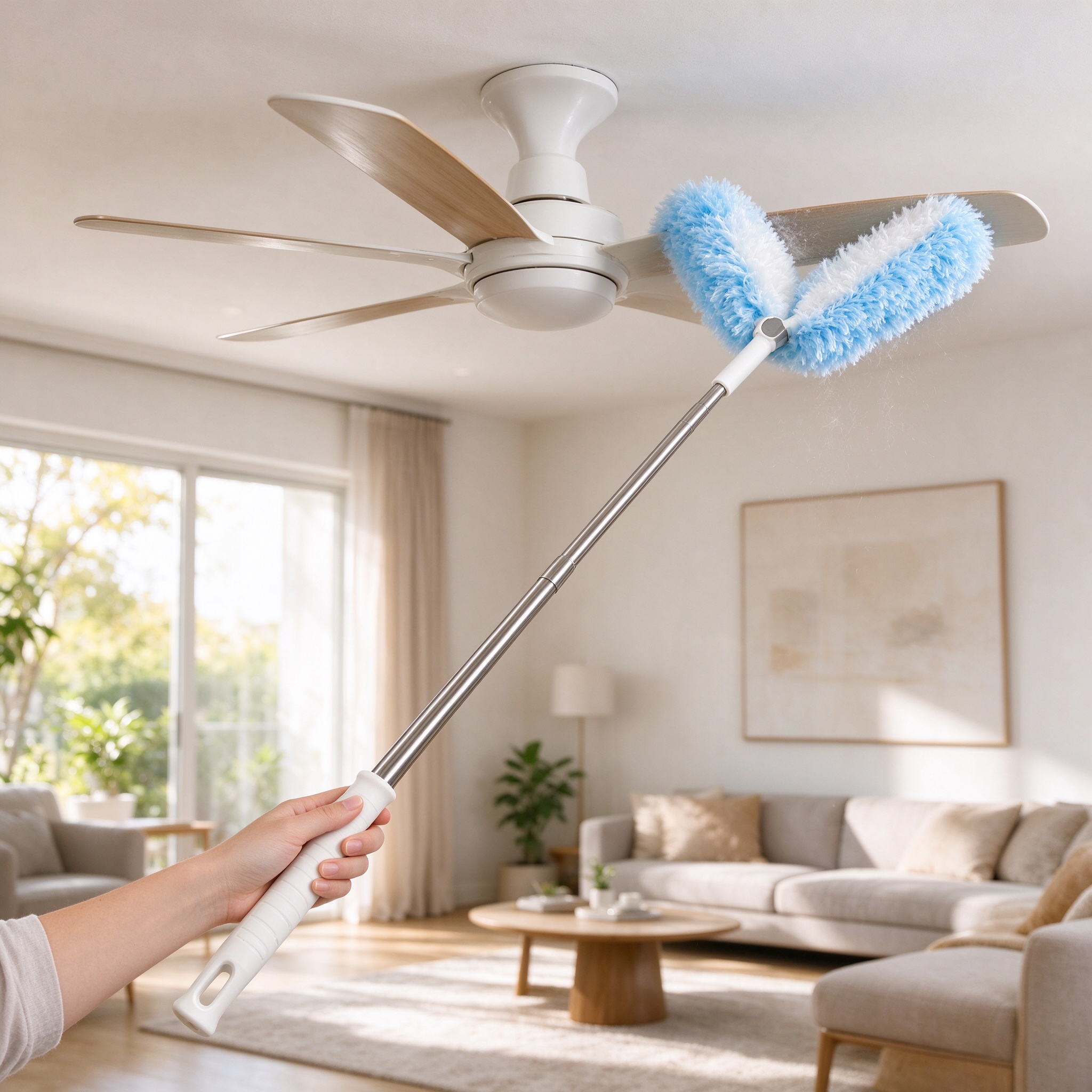
The 2026 model extends from roughly 56 centimeters (about 22 inches) to 210 centimeters (about 83 inches) — nearly 7 feet. Combined with a standing adult arm reach of roughly 5 to 6 feet, that means you can clean the top of a 9-foot ceiling without moving a chair. You can stand on the floor of the great room and wipe the top of a 10-foot bookshelf. You can reach the center of a ceiling fan blade from the floor of the bedroom. The pole is stainless steel, so it is rigid when extended, light when collapsed, and will not rust after a rinse.
Pillar 2 — A Dual-Head, 180° Bendable Design
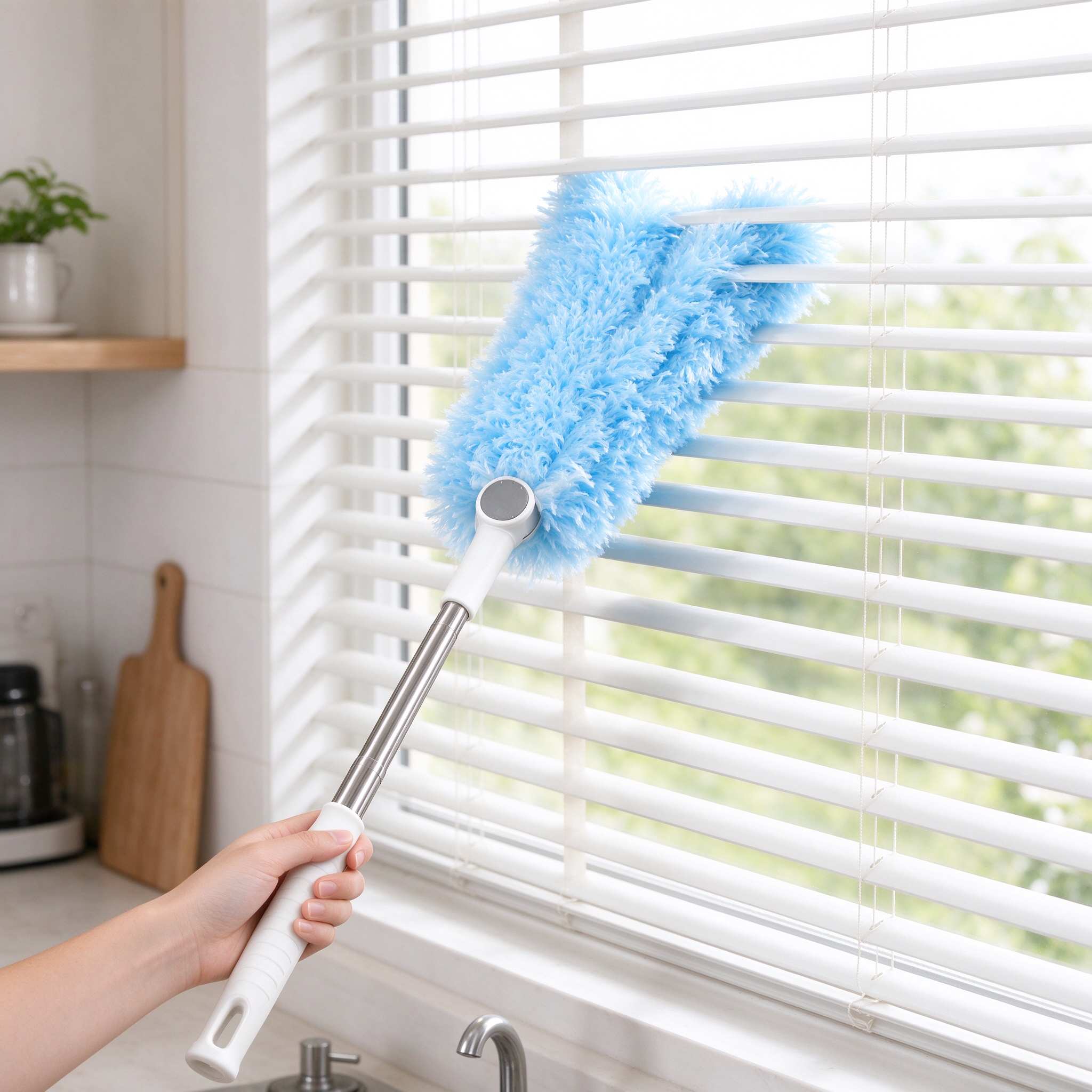
The head is not a single fixed wand. It is a V-shaped dual-head that bends 180 degrees at the neck. This is the design detail that converts the duster from "okay" to "indispensable."
Bent flat, the head lays across the top of a ceiling fan blade and cleans the entire length of the blade in one pass.
Angled vertically, it slips between the slats of window blinds.
Curled into a "U," it wraps around a chandelier arm or a curtain rod.
Folded straight, it reaches into the narrow gap between the refrigerator and the wall.
A rigid duster can clean a flat surface. A bendable dual-head duster can clean around corners, under overhangs, and over the top of furniture.
Pillar 3 — Soft, Fluffy, Washable Microfiber
The head is the soft, fluffy light-blue microfiber you see in the product photos. It is gentle enough for TV screens, picture frames, and delicate lamp shades, and dense enough to grab heavy pet hair from a bookshelf. When it gets dirty, you simply slide it off, rinse it under warm water, let it air-dry, and slide it back on. The package comes with two replacement heads, so you can keep one on the pole while the other dries.
Pillar 4 — A Lightweight, Balanced Handle
The entire duster weighs less than a pound. The handle is a textured, non-slip white grip with a hanging hole at the bottom, so you can store it on a hook in the closet, in the utility room, or behind the door. When the pole is fully extended, the balance point sits close to the lower hand, so you do not feel like you are lifting a crowbar overhead for ten minutes.
Pillar 5 — No Ladder, No Stepladder, No Risk
The single biggest benefit of an extendable duster is not time. It is safety. Every year, emergency rooms in the United States treat thousands of falls from ladders and step stools during spring cleaning. The U.S. Consumer Product Safety Commission estimates that ladder-related injuries send hundreds of thousands of Americans to emergency rooms annually. Most of those falls happen not on construction sites, but in homes — on a 4-foot step stool, reaching for the top shelf. A 7-foot extension pole removes that risk entirely. You keep both feet on the floor, you keep one hand on the pole, and you clean the ceiling fan without anyone in the family holding the ladder for you.
6. Six Buyers Who Will Immediately Understand the Value
Buyer A — The Suburban Homeowner With Vaulted Ceilings
You have a 2-story foyer, a great room with a 12-foot ceiling, and a chandelier over the dining table. You used to drag a 6-foot ladder out of the garage twice a year. Now you extend the pole to 7 feet, stand on the floor, and clean in 15 minutes.
Buyer B — The Pet Owner With Dogs and Cats
Pet hair ends up on top of the bookshelf, on top of the TV, on the curtain rods. A vacuum with the upholstery attachment picks it up on the floor. The microfiber duster picks it up overhead. The static holds the hair until you rinse the head.
Buyer C — The Allergy or Asthma Sufferer
You cannot afford to stir dust into the air. A feather duster makes you sneeze for an hour afterward. A microfiber duster traps the particles, and a washable head means you are not spraying the same allergen cloud at the next use.
Buyer D — The Airbnb or Short-Term Rental Host
Your turnover happens between noon and 3 p.m. You cannot drag a ladder into every unit. The extendable duster lets a single cleaner wipe the ceiling fan, the top of the cabinets, and the blinds in three minutes per room.
Buyer E — The Elderly Homeowner
You should not be climbing on chairs. The 7-foot reach means you stay on the ground. The lightweight pole means you can hold it overhead without straining your shoulder.
Buyer F — The Office Manager or Property Manager
Offices have ceiling vents, cubicle walls, bookshelves, and blinds that never get dusted. A single extendable microfiber duster cleans the entire lobby in an hour.
7. Where You Actually Use It: The Full List
The product photos show seven core use cases. In a real American home, the list is longer:
Ceiling fan blades — the #1 reason people buy this duster.
Window blinds — horizontal, vertical, and plantation shutters.
Bookshelves and display cabinets — the top shelf, especially.
TV screens and electronics — gentle microfiber will not scratch.
Top of kitchen cabinets — that 12-inch gap above the upper cabinets.
Walls, corners, and crown molding — cobwebs in the high corners.
Ceiling light fixtures and chandeliers — without taking them down.
Curtain rods and curtain tops — without pulling the curtains down.
Shelves in the garage, attic, and basement — where cobwebs live.
Baseboards and vents — when the pole is collapsed short.
That is the point of a dual-head bendable duster: it is one tool that replaces the feather duster, the lambswool wand, the blind squeegee, and the cobweb brush.
8. The Math: How Much Time (and Risk) You Actually Save
Picture a typical spring-cleaning Saturday. Without the right tool, cleaning a 2,000-square-foot suburban home's high surfaces goes like this:
Get the 6-foot ladder out of the garage. (5 minutes)
Set it up under the ceiling fan. (2 minutes)
Climb up, wipe the blades with a rag. (5 minutes, with dust falling on your face)
Move the ladder to the chandelier. (2 minutes)
Climb up again. (3 minutes)
Move the ladder to the bookshelf. (2 minutes)
Wipe three shelves. (10 minutes)
Move the ladder to the blinds. (2 minutes)
Wipe each slat with a rag over your fingers. (15 minutes)
Move the ladder to the kitchen cabinets. (2 minutes)
Wipe the top. (8 minutes)
Carry the ladder back to the garage. (3 minutes)
That is roughly an hour's work, much of it spent on and off a ladder, and you will be sneezing by the end.
With the extendable duster:
Grab the duster from the closet. (10 seconds)
Extend the pole. Bend the head. Clean the fan. (3 minutes, feet on the floor)
Walk across the room. Clean the chandelier. (2 minutes)
Walk to the bookshelf. Clean the top two shelves. (3 minutes)
Walk to the window. Run the dual head down the blinds. (2 minutes)
Walk to the kitchen. Wipe the top of the cabinets. (3 minutes)
Rinse the head, hang the duster back up. (2 minutes)
Total: roughly 15 minutes. You saved 45 minutes, you never climbed anything, and the dust went into the microfiber — not onto your face.
Over a year of monthly dusting, that is roughly 9 hours of your life recovered. Over a decade, it is three full weeks.
9. Sustainability and Economics: The Reusable Case
The microfiber duster is also one of the few cleaning tools whose economics improve the longer you own it.
A disposable duster head (the kind you buy in a plastic pack, use once, and throw away) costs roughly $1 to $2 per head. If you dust twice a month, that is $24 to $48 a year, and you are sending 24 plastic-and-fiber heads to a landfill. A washable microfiber head costs roughly $5 to $8, lasts for years, and can be rinsed or machine-washed hundreds of times.
The package includes two replacement heads, so the initial buy covers roughly two years of monthly dusting before you even think about ordering more. The U.S. Environmental Protection Agency has been pushing for reduced single-use plastics in household products, and washable microfiber is exactly the kind of swap that environmental groups, county extension offices, and consumer-recommendation columns have been highlighting for a decade.
For allergy sufferers, the reusable head has a second benefit: you control how often it is washed. A disposable head sits in a plastic bag in your closet, picking up who-knows-what until you open it. A microfiber head you rinse after every use is visibly clean.
10. What to Look For: An 8-Point Buyer's Checklist
If you are comparing extendable dusters on Amazon, Walmart, or Home Depot, use this list:
Maximum reach — at least 7 feet (200 cm). Anything shorter and you still need a chair.
Head bend — 180-degree adjustable head, not a fixed wand.
Microfiber quality — fluffy, split-fiber, not flat nylon.
Washable and replaceable — the head slides off. If it is glued on, skip it.
Pole material — stainless steel, not thin aluminum that bends.
Weight — under 1 pound. Heavier and your arm will tire.
Handle — textured grip with a hanging hole.
Included refills — two spare heads are the standard package; one is a red flag.
11. Before and After: Two Weekends in the Same House
Before. It is mid-March. You are hosting Easter brunch next Sunday. You look up at the ceiling fan and see a gray film on every blade. You look at the blinds and see dust streaks. You look at the top of the kitchen cabinets and decide, again, that you will "do it later." Brunch comes. Your mother-in-law looks up at the fan and says nothing. You know.
After. It is 10 a.m. on a Saturday. You pull the duster out of the closet, extend it to 7 feet, bend the dual head, and walk through the house. Fifteen minutes later, the fan blades are clean, the blinds are clean, the bookshelf top is clean, the chandelier is clean. You rinse the head in the sink, hang it up, and go make coffee. Brunch happens. Nobody has to say anything.
That is what a well-designed extendable microfiber duster actually buys you: not a cleaner house in the abstract, but a smaller, quieter, less shameful gap between the house you live in and the house you want people to see.
12. Closing: The Tool That Looks Up
Most cleaning tools are designed for the floor. The vacuum, the mop, the broom — all of them keep your eyes pointed down. The extendable microfiber duster is the rare tool that asks you to look up.
It reaches the ceiling fan that has not been touched since you moved in. It cleans the blinds you walk past twice a day. It wipes the top of the bookshelf where the holiday decorations sit in boxes. It gets the cobwebs out of the high corners in the guest bedroom. It handles the top of the kitchen cabinets that have been dusty since the day the house was built.
You do not need a ladder. You do not need a professional cleaning service. You do not need to spend an entire Saturday. You need a 7-foot telescopic pole, a bendable microfiber head, and fifteen minutes.
The 2026 extendable microfiber duster is not a complicated product. It is a simple one: a long pole, a fluffy head, a washable cover. But the simplicity is the point. American homes have gotten taller, dustier, and harder to reach over the last thirty years, and the cleaning aisle has finally caught up.
This spring, when the 80% of Americans who say they will spring clean pull out their supplies, more and more of them will reach for the extendable duster instead of the ladder. When they finish, they will look up at the ceiling fan, see clean blades, and never go back.



