


It's 6:42 on a Tuesday. You overslept, you're already ten minutes late, and you grab your 40-ounce Stanley Quencher out of the cup holder. Yesterday's iced oat latte still smells faintly sweet — but underneath it, there's something else. A sour, fermented, almost bready smell that you've learned not to mention out loud in front of your partner.
You pop the lid, squint at the silicone seal ring, and there it is: a thin, dark, slime-colored line tucked right where the plastic meets the rubber. The kind of gunk that a normal bottle brush cannot reach, a dishwasher cycle half-works on, and a paper towel smear just spreads around.
You rinse it with hot water, hope for the best, and pour your coffee. This is the moment the 3-in-1 lid brush was built for.
1. 6:42 AM, the lid that wouldn't open
It's 6:42 on a Tuesday. You overslept, you're already ten minutes late, and you grab your 40-ounce Stanley Quencher out of the cup holder. Yesterday's iced oat latte still smells faintly sweet — but underneath it, there's something else. A sour, fermented, almost bready smell that you've learned not to mention out loud in front of your partner.
You pop the lid, squint at the silicone seal ring, and there it is: a thin, dark, slime-colored line tucked right where the plastic meets the rubber. The kind of gunk that a normal bottle brush cannot reach, a dishwasher cycle half-works on, and a paper towel smear just spreads around.
You rinse it with hot water, hope for the best, and pour your coffee. This is the moment the 3-in-1 lid brush was built for.
2. The American tumbler you own
The American insulated tumbler is no longer a piece of gear. It is an identity.
Stanley's Quencher 40 oz is, by every retail count on record, one of the biggest lifestyle launches of the 2020s. Yeti Ramblers sit in every suburban truck cup holder. Hydro Flasks line high school lockers. Owala brought the straw lid to the parent-carpool circuit. Owala, Brümate, simple modern, Corkcicle — the list goes on. Each one shares the same structural problem: a lid made of three or four pieces of plastic, a silicone seal ring that comes out (sort of), a straw that slides through a hole, and a thread on the bottle neck that catches coffee residue.
The marketing pictures you see on TikTok never show the seal ring. They show condensation running down a bright fresh bottle in sunlight. The reality, six months in, is a lid that needs a screwdriver, a toothpick, and about forty minutes to really clean.
3. Why every "normal" cleaning tool fails the lid
If you have owned a tumbler for more than a month, you have already tried three things:
The dishwasher. Manufacturers say it's dishwasher-safe. They mean the body. They do not mean the seal ring. A dishwasher blasts the outside of the lid and leaves the underside — where milk sugars curdle — basically untouched. And the seal ring, popped out and left on the top rack, usually vanishes forever into the appliance.
A regular bottle brush. The big sponge-on-a-stick is built for the inside of the bottle. It cannot bend around the lid's inner lip. It cannot reach the straw hole. It cannot get between the silicone ring and the plastic channel it sits in.
A toothpick or a Q-tip. This is what you actually do. You stab at the seal ring groove with a wooden toothpick, then swipe with a damp Q-tip, and the Q-tip comes up gray. You are also, by the way, introducing wood splinters and cotton lint into the gasket.
The problem is geometric. A lid is a system of narrow slots: the straw bore, the gasket channel, the bottle neck thread, the sip opening. No single brush tip has ever been shaped to attack all three.
Until now.
4. What's in the pack
The 3-in-1 lid brush is one small stick, about the size of a fat marker, that combines three engineered tips into one handle.
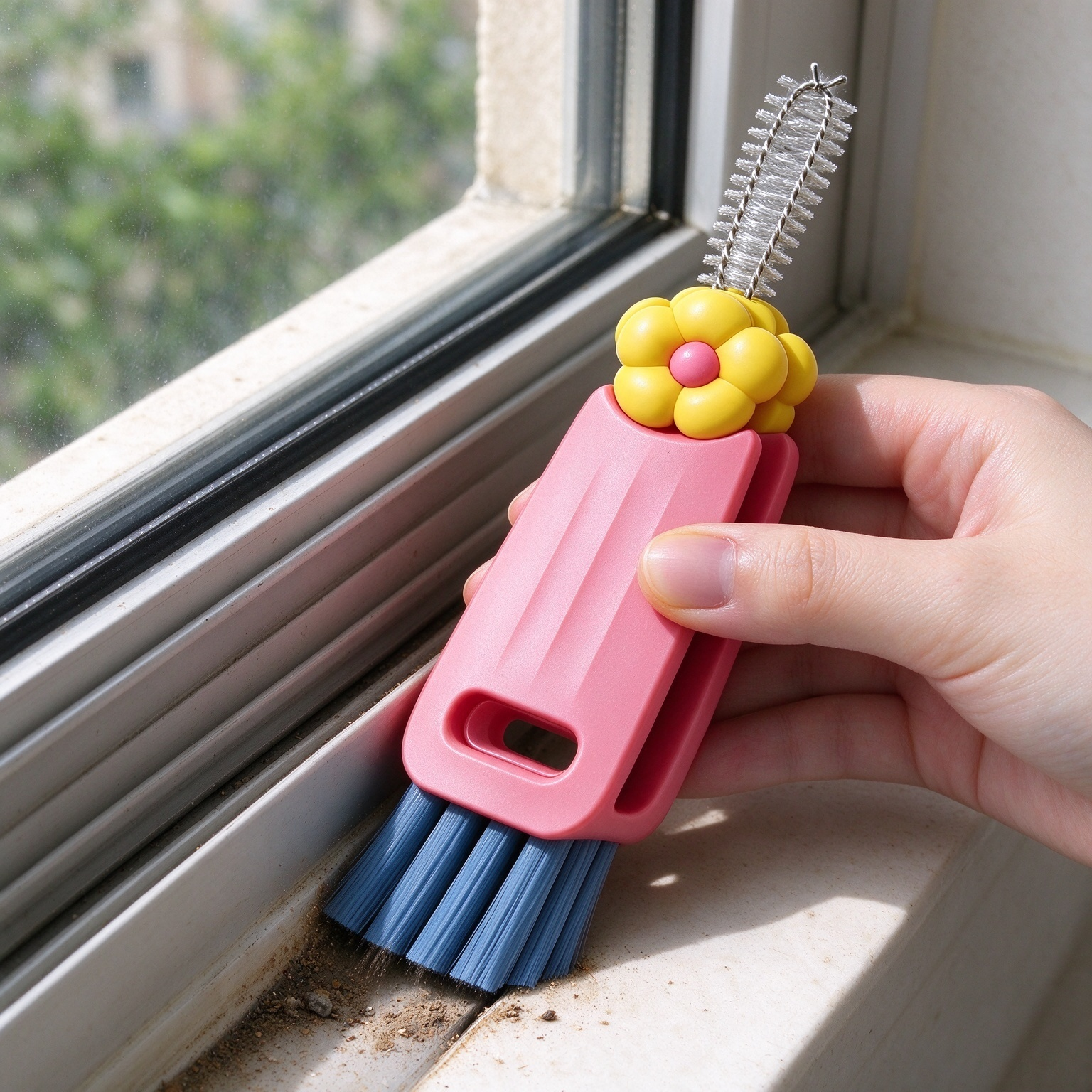
The main bristle strip — four rows of dense, soft blue nylon bristles on a flat head. This is the workhorse. It scrubs the bottle neck threads, the lid's outer underside, and the surface of the seal ring itself.
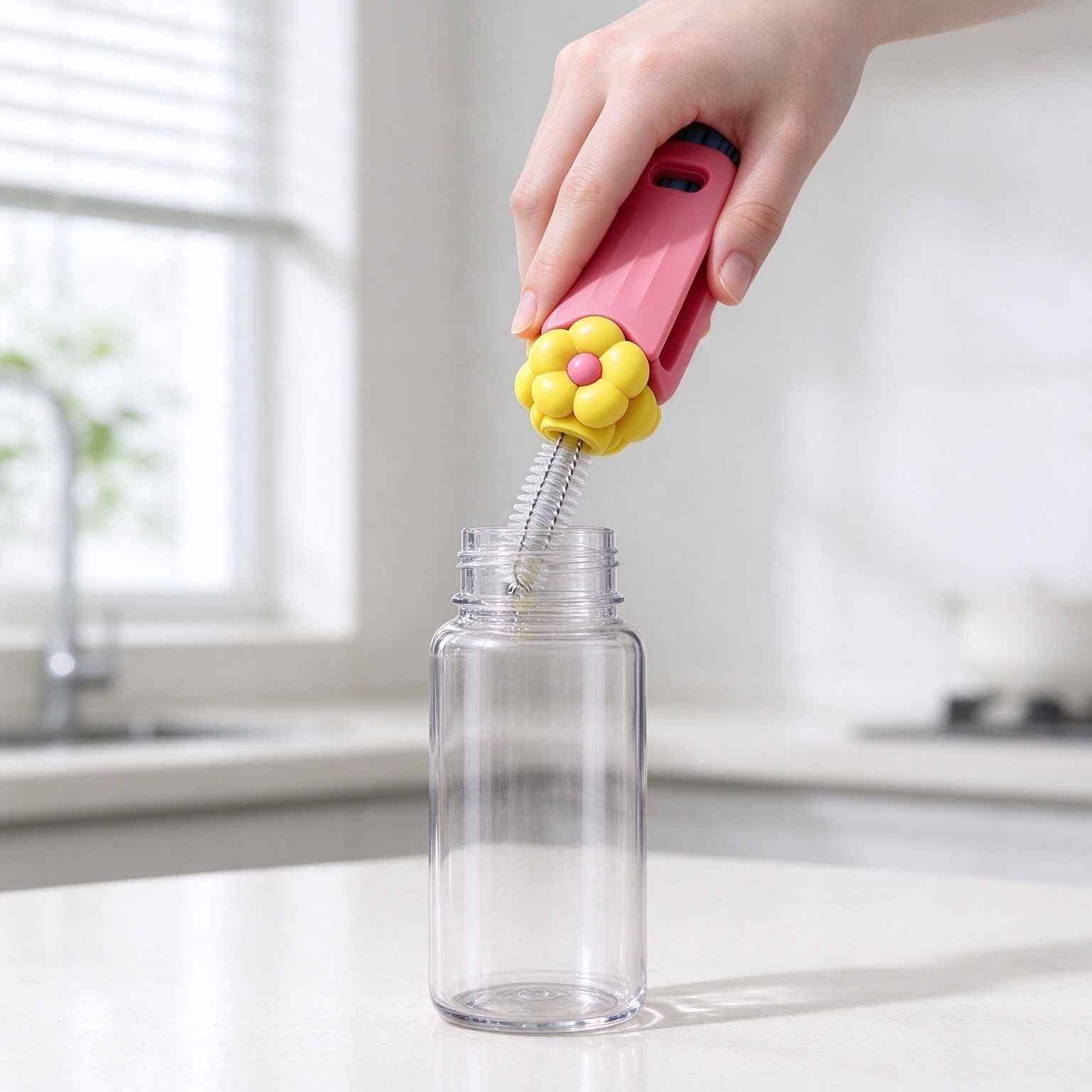
The thin spiral detail brush — a slim nylon-wrapped wire brush on a flex neck, sprouting up from the flower-shaped top of the handle. This goes inside straws, spouts, and the tiny holes in sip lids. Its spiral design grabs slime the way a bottle brush grabs the inside of a cup.
The flat silicone scraper pick — a narrow, rigid, orange-colored pick on the other end, shaped to slide under the silicone seal ring, lift it out of its groove, and scrape the black film that collects on the channel floor without scratching plastic.
A hanging hole through the handle, so the whole tool dries between uses.
Cute flower deco on top in yellow, pink, or orange — a deliberate nod to the kitchen-cute aesthetic of 2026.
The three tips rotate. The main brush is fixed. The spiral brush slides out and the pick folds out, depending on which of the three problems you're solving.
5. The six jobs
Job 1 — The seal ring
Pop the silicone gasket out of its channel (the scraper pick end is made exactly for this prying step). Brush the channel floor with the flat bristle strip. Rinse the gasket itself under hot soapy water. Drop the gasket back. Thirty seconds. No more black line.
Job 2 — The straw / spout
The spiral tip slides into the 0.4-inch straw of an Owala or Brümate, runs up and down twice, and pulls out the yogurt-milk-coffee slime that has been building since Tuesday.
Job 3 — The bottle neck thread
The flat bristle strip wraps around the exposed thread on a Hydro Flask or Yeti and scrubs the brown ring of dried coffee that a sponge always misses.
Job 4 — The lid underside
With the lid disassembled, the bristle strip follows the molded plastic valleys where milk fat sits. You can see the soap foam lift the residue in real time.
Job 5 — The keyboard gap
Yes, the product pictures show this. The slim bristle strip slides between laptop keys and around mechanical keyboard switches, pulling out crumbs. It's a "while you're at it" bonus, not the main sale — but people buy the tool because they see it solve two problems at once.
Job 6 — Kids' sippy cups and baby bottles
Parents of toddlers know: a 6-ounce sippy cup with a straw gets a moldy ring in about ten days. The spiral tip reaches the straw, the bristle strip reaches the valve, the pick pries the silicone flap out.
6. Why this geometry, why these materials
Nylon bristles are chosen for a reason. They are stiff enough to lift coffee tannin and milk fat from plastic, but soft enough not to scratch the food-grade polymer that the lids are molded from. The spiral-wrapped wire detail brush is flexible — it bends through a curved straw rather than poking straight through and getting stuck. The silicone pick is rigid, so it does the prying job of a fingernail without actually being a fingernail, which is where you normally cut yourself.
BPA-free. It sits next to the kids' bottles on the sink. You want to be able to read that claim on the card.
The hanging hole closes the loop: a wet brush that sits on a sink ledge grows its own slime in a week. On a hook, the bristles air-dry in three hours.
7. The actual cost of a dirty lid
A new tumbler lid, replaced because it smells: $12–$25. People buy these on Amazon all the time.
A whole new tumbler, because the lid is unsalvageable: $30–$45 (Stanley), $30 (Yeti), $50+ (Owala FreeSip).
A mold-sick child who refuses their bottle: no price tag, but it ruins the morning.
A bottle brush you already own: $8. It doesn't fit the problem.
This 3-in-1 lid brush: about the price of one replacement lid. It lasts years.
8. The 8-point checklist before you buy any lid brush
Three tips, not one. A single-tip brush only solves the straw and leaves the gasket.
Nylon bristles, not steel. Steel scratches the lid's plastic and leaves micro-grooves that hold more gunk.
Flexible spiral tip for straws. A rigid wire brush gets stuck in curved straws.
A prying pick for the gasket. Your fingernail is the wrong tool.
BPA-free and food-contact safe. It touches what you drink from.
Hanging hole. Wet brushes grow their own mold.
Small enough to store in a utensil crock. If it doesn't fit the drawer, it doesn't get used.
Dishwasher-friendly or easy to rinse. You should be able to run it under the tap and be done.
9. Tuesday, before / after
Before. 6:42 AM. You sniff the lid. You notice the dark line. You rinse with hot water, decide it's fine, and drive to work. By 2 PM you're wondering why your iced latte tastes sour. You buy a disposable at the office. $5.
After. 9:08 PM, Sunday. You stand at the sink. Pop the gasket with the orange pick. Brush the channel with the blue strip. Run the spiral tip up the straw. Rinse. Snap the lid back together. Hang the brush on its hook. Monday morning the tumbler smells like the clean, empty plastic it is supposed to smell like.
10. The 2026 trend
American kitchens 2026 are done with disposable cups. Starbucks' "bring your own tumbler" discount is permanent. TikTok is in its fourth year of "Stanley girl" culture. The pediatric industry keeps publishing guidance about mold in sippy cup valves. The kitchen-organizing category is full of small, colorful, task-specific tools — the opposite of the one-tool-does-all era.
A tiny three-tip brush in pink, blue, and lime green, topped with a plastic flower, is exactly that trend. It doesn't try to be a big thing. It is the small thing you did not know you needed until you smell the lid.
11. Who this is for
The commuter who drinks out of the same 40-ounce tumbler every day. The parent whose toddler's sippy cup gets moldy rings. The gym-goer who uses a straw bottle and has given up on the straw. The office worker whose Hydro Flask thread has a brown ring. The outdoor-cooker whose Yeti Rambler sits in a truck cup holder for six months. The parent of a daycare kid who comes home with a bottle that smells like last Tuesday's yogurt.
For each of these hands, this little stick does the same small job. It reaches the place your bottle brush cannot. It pries the gasket out without breaking a nail. It rinses clean and hangs dry.
It is, after all, the tool for the part of the tumbler no one ever designed a tool for.



