


Every kitchen has a hidden contradiction. The tool we trust to make our dishes clean is often, itself, the dirtiest object in the room. The kitchen sponge — that familiar yellow-and-green block sitting beside every sink in America and Britain — is a porous universe of moisture, food residue, and warmth. Those are precisely the conditions bacteria need to thrive. The numbers are not anecdotal; they are structural. Studies cited by public health authorities have found that a well-used dish sponge can harbor as many as 54 billion bacteria per cubic centimeter — a density that makes the average toilet seat look positively sanitary. Researchers at the German Federal Institute for Risk Assessment reported in 2026 that foodborne pathogens including Salmonella, E. coli, and Staphylococcus aureus can survive in a sponge's porous structure for more than two weeks.
And yet, most households still reach for that same sponge, day after day, believing they are cleaning.
This is the paradox that defines the modern kitchen — and it is exactly the opening that 2026's smarter cleaning tools are designed to close. The 3-in-1 kitchen cleaning brush is not merely another gadget on the shelf. It is a considered answer to three separate failures of the old way: the hygiene failure of the sponge, the efficiency failure of specialized single-purpose tools, and the durability failure of disposable everything. This article examines why the three-in-one brush — combining scrub, scrape, and clean functions in a single tool with a comfortable grip and durable materials — has become the category-defining kitchen tool of 2026, and why the data, the culture, and the market are all pointing in the same direction

2026: One Brush, Three Powers — Scrub, Scrape, Clean Like Never Before
Every kitchen has a hidden contradiction. The tool we trust to make our dishes clean is often, itself, the dirtiest object in the room. The kitchen sponge — that familiar yellow-and-green block sitting beside every sink in America and Britain — is a porous universe of moisture, food residue, and warmth. Those are precisely the conditions bacteria need to thrive. The numbers are not anecdotal; they are structural. Studies cited by public health authorities have found that a well-used dish sponge can harbor as many as 54 billion bacteria per cubic centimeter — a density that makes the average toilet seat look positively sanitary. Researchers at the German Federal Institute for Risk Assessment reported in 2026 that foodborne pathogens including Salmonella, E. coli, and Staphylococcus aureus can survive in a sponge's porous structure for more than two weeks.
And yet, most households still reach for that same sponge, day after day, believing they are cleaning.
This is the paradox that defines the modern kitchen — and it is exactly the opening that 2026's smarter cleaning tools are designed to close. The 3-in-1 kitchen cleaning brush is not merely another gadget on the shelf. It is a considered answer to three separate failures of the old way: the hygiene failure of the sponge, the efficiency failure of specialized single-purpose tools, and the durability failure of disposable everything. This article examines why the three-in-one brush — combining scrub, scrape, and clean functions in a single tool with a comfortable grip and durable materials — has become the category-defining kitchen tool of 2026, and why the data, the culture, and the market are all pointing in the same direction.
The Problem Nobody Wanted to Talk About: Your Sponge
Let us be direct about the elephant in the sink. The kitchen sponge is one of the most contaminated objects in the average household — and according to multiple studies, one of the most contaminated objects in the entire home. Its structure is the problem. The sponge's porous matrix absorbs water, oil, and food particles with every use, creating a damp, nutrient-rich environment where bacteria multiply at room temperature. Research has documented bacterial densities of up to 54 billion organisms per cubic centimeter in used sponges. For context, the average toilet seat carries roughly 100,000 bacteria per square centimeter. The sponge you hold in your hand is, by a wide margin, the dirtier of the two.
The implications are uncomfortable but clear. When you wipe a countertop with a used sponge, you are not only picking up residue — you may be redistributing bacteria across the very surfaces you are trying to sanitize. When you scrub a plate and then set the sponge down in the sink, you are seeding the next wash cycle with whatever has been growing inside those pores since yesterday. The standard advice — microwave the sponge, soak it in vinegar, replace it monthly — is a patchwork of damage control on a fundamentally flawed tool.
The 3-in-1 brush answers this at the root. A brush does not absorb. Its bristles and scraper are open structures that drain, dry quickly, and do not trap moisture or food debris in the way a sponge does. The tool itself stays cleaner — and because it is built to last, it does not need the constant replacement cycle that sponges do. That is not a marketing claim. It is a change in the physics of the tool.
One Tool, Three Powers: The Design Logic
The genius of the three-in-one design is not that it combines three functions — it is that it combines the three functions that a kitchen actually needs, in the order in which a kitchen actually needs them.
Scrub: Tough on Grease and Grime
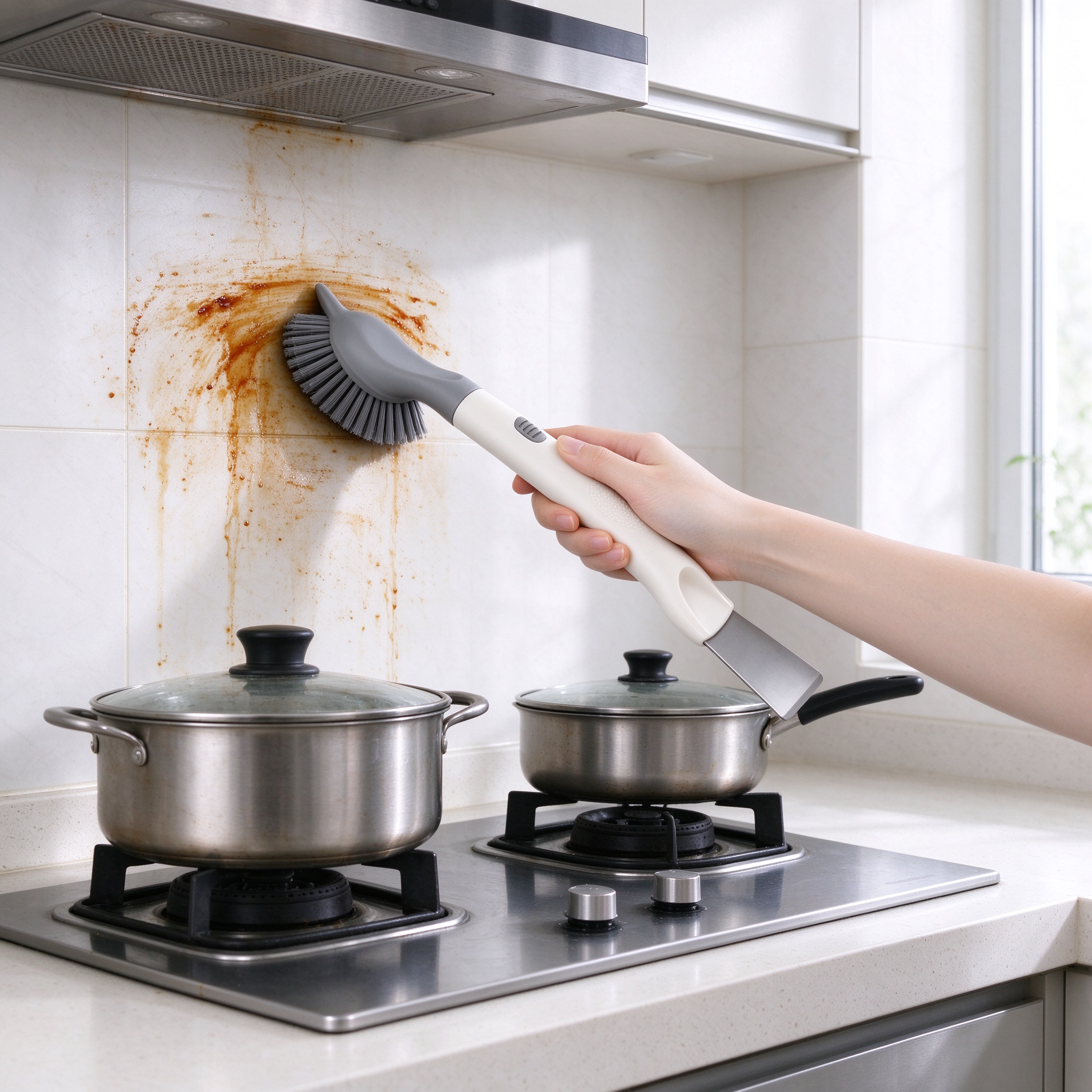
The first power is brute-force cleaning. Grease films, dried sauces, coffee stains, the tacky residue left behind on stove tops and countertops — these are the everyday enemies of a working kitchen. The brush's scrubbing face is engineered for this: dense bristles that agitate and lift rather than smear, built to cut through grease without scratching the surfaces beneath. Where a sponge smears a thin layer of oil across a larger area, a well-designed scrub face lifts and contains the grime, leaving the surface genuinely clean.
Scrape: The Baked-On Problem Solver
The second power is the one that separates a three-in-one from an ordinary dish brush. Baked-on food — the crusted edge of a lasagna pan, the caramelized residue at the bottom of a saucepan, the scorched bits clinging to a roasting tray — is the most frustrating cleaning task in the kitchen. It resists soap, resists soaking, and historically requires either a dedicated scraper (another tool in the drawer) or a metal scourer (which damages non-stick coatings). The integrated scraper edge of the three-in-one brush solves this within the same tool: a firm edge that lifts baked-on residue without gouging the cookware, controlled by the same comfortable grip you are already holding. It turns the most dreaded post-cooking chore into a twenty-second pass.
Clean: Deep Into Hard-to-Reach Areas
The third power is precision. Kitchens are full of places that brushes and sponges cannot comfortably reach: the drain opening of the sink, the rim where the sink meets the counter, the corners of a roasting tray, the gaps around stove knobs. The brush's tip and edge are shaped to reach into these tight geometries — cleaning the drain guard, the crevices, and the joints that accumulate hidden grime. This is the function that most households discover only after a year of owning the brush: the tool that finally cleans the places they had quietly given up on.
Why Three-In-One Beats Three Tools
There is an obvious objection: why not simply own a brush, a scraper, and a small crevice tool? The answer lies in the way kitchens actually work — and in what a single integrated tool provides that three separate tools cannot.
Space. Kitchens are the most space-constrained rooms in modern homes, and the drawer that holds cleaning tools is usually the first casualty. One tool instead of three means one drawer slot, one item to hang, one object to keep track of. For small kitchens, rental kitchens, and anyone who has ever opened an overstuffed utensil drawer, this is a tangible daily relief.
Time. Every kitchen task has a switching cost. When cleaning a single pan requires reaching for the brush, then the scraper, then the sponge, the chore fragments into multiple motions. The three-in-one keeps the workflow continuous: scrub, scrape, wipe — all with the same tool in hand. Small savings, repeated dozens of times a day, become a measurable difference in how long dinner cleanup takes.
Consistency. A tool you own and use is a tool that works. The kitchen is littered with specialized gadgets that get used twice and forgotten. The three-in-one brush, by contrast, is the tool that lives beside the sink and gets reached for every day — because it is the tool that covers the actual range of daily tasks. Its value is not theoretical; it is accumulated in daily use.
The Comfort and Materials of a Tool You Use Every Day
Design details matter most in tools that are used constantly. The 3-in-1 kitchen cleaning brush is built around two specifications that reflect this: a comfortable, non-slip grip and durable materials.
The grip is the interface between the user and the task. A dish brush that slips in soapy hands, that digs into the palm during a long scrub, or that feels cheap and flexes under pressure — these are not minor complaints; they are the reasons tools get abandoned. The three-in-one's ergonomic handle is designed for wet, soapy conditions: a textured, non-slip surface that maintains control even when your hands are covered in suds. Long cleaning sessions — the Sunday pot wash, the post-roast pan rescue — are tasks where grip comfort translates directly into less fatigue and better results.
The materials answer the durability question that disposable culture trained us to stop asking. A kitchen tool should not be a quarterly expense. The three-in-one is built from hard-wearing materials chosen to survive years of daily use: bristles that hold their shape, a scraper edge that stays firm, a handle that does not crack or corrode. Where the sponge is a consumable that must be repurchased and discarded on a cycle, the brush is an asset — bought once, used daily, depreciated over years.
The Hygiene Argument, Made Practical
We began with the sponge's bacterial load, and it is worth returning to it — because the hygiene case for the brush is not abstract. It is the most concrete argument in this entire category.
The sponge's failure mode is structural: absorbent, porous, perpetually damp. The brush's success mode is equally structural: open bristles, fast draining, quick drying. A brush does not give bacteria the reservoir that a sponge does. It does not hold water overnight. It does not carry yesterday's food particles into today's clean dishes. And because it is not replaced on a disposal cycle, it does not quietly send thousands of sponges into landfills every year.
This is the combination that matters to modern households: better hygiene for the people eating from the dishes, and less waste for the planet the dishes are cleaned on. It is rare to find a product where the health argument and the environmental argument point in exactly the same direction. The three-in-one brush is that product.
The Market's Answer: Why the Industry Is Moving This Way
The shift is not a niche preference; it is a market movement. Industry research projects the global kitchenware market to grow at a compound annual rate of roughly 5.8% from 2024 through 2030, with eco-friendly and multifunctional cleaning products among the fastest-moving segments. Consumer surveys and retailer data across the US and UK consistently show rising demand for tools that serve multiple purposes, use durable materials, and reduce reliance on disposables. The three-in-one brush sits precisely at the intersection of these curves: multifunctional by design, durable by construction, and sponge-replacing by implication.
The cultural current is moving in the same direction. The past five years have shifted kitchen discourse from "how to clean" to "what you clean with" — a conversation about materials, bacteria, and waste that would have been unthinkable a decade ago. Documentaries, consumer investigations, and mainstream media coverage of sponge contamination have done what advertising could not: they have made the absorbent sponge's hidden cost visible. When the most-cited statistic about a cleaning tool is that it harbors 54 billion bacteria per cubic centimeter, the market does not need convincing — it needs a better tool. 2026 is the year that better tool arrives with the design maturity to match the demand.
How to Get the Most From a Three-In-One Brush
Like any quality tool, the three-in-one rewards proper use. A few habits extend its life and its effectiveness:
Rinse and stand it upright after use. The brush's open structure dries quickly when given airflow. Standing it bristle-up (or hanging it) after rinsing keeps it clean and ready.
Scrape before you soak, or after. For baked-on residue, the scraper works best either as a first pass to lift the worst of it or as a final pass after soaking softens the crust. Both approaches spare the brush's bristles from excessive wear.
Let the brush do the abrasive work. The scraper is designed for stubborn residue; the bristles are designed for everyday grime. Using each for its intended role keeps both in peak condition.
Replace only when genuinely worn. A quality brush lasts for years. When bristles finally splay or the scraper edge wears, replace it — and note how rarely that moment comes compared with the sponge cycle you have left behind.
Why 2026 Is the Turning Point
Timing is not incidental. Three forces have converged to make 2026 the year the three-in-one brush becomes the default answer in the kitchen.
First, the hygiene evidence has reached critical mass. The studies on sponge contamination are no longer obscure academic findings; they are mainstream headlines, cited in kitchens rather than journals. Second, the sustainability shift has moved from values to behavior: consumers are actively trading disposables for durables, and retailers have the shelf space to prove it. Third, the design has matured. Earlier multi-tools were gadgets — compromise objects that did several things poorly. The new generation, built around comfortable grips and genuinely durable materials, does each function well enough to replace the dedicated tool. When a single object outperforms the three objects it replaces, the drawer itself makes the decision.
None of this requires a lifestyle overhaul. It requires one swap — the same swap that replaces a monthly sponge purchase with a once-every-few-years brush — and the kitchen quietly reorganizes itself around a better tool.
Who This Product Is For
The ideal user of the three-in-one brush is broader than any single demographic. It is the home cook who roasts and bakes and has declared war on baked-on residue. It is the busy parent who wants the evening cleanup to take minutes, not a siege. It is the renter with limited drawer space and the minimalist who measures purchases against usefulness. It is the hygiene-conscious household that read the sponge statistics and decided not to ignore them. It is the environmentally minded shopper looking for products that are bought once and used for years. And increasingly, across the US and UK, it is all of these people in the same household — because the three-in-one answers each of their concerns with the same tool.
The Verdict: The Tool the Kitchen Was Waiting For
The cleaning drawer tells the story of the modern kitchen: a graveyard of single-purpose gadgets, disposable sponges, and tools bought for one task and used for none. The three-in-one kitchen cleaning brush is the correction. It scrubs what needs scrubbing, scrapes what needs scraping, and reaches what needs reaching — with one comfortable grip, one set of durable materials, and one place in the drawer.
The numbers make the case: a sponge that harbors 54 billion bacteria per cubic centimeter and is discarded on a monthly cycle, versus a brush that drains, dries, and lasts for years. The market makes the case: a kitchenware sector growing at nearly 6% annually, powered by exactly the multifunctional, durable, sponge-replacing products this brush represents. And the kitchen itself makes the case, every evening, when one tool in hand completes what three tools once struggled to do.
In 2026, the question is no longer whether to upgrade from the sponge. It is why anyone still has one.



